
In the past, contamination control was often managed in silos: HVAC handled ventilation, Architecture handled walls/ceilings/floors, and QA handled cleaning procedures. But under the updated EU GMP Annex 1, that approach is no longer sufficient.
A Contamination Control Strategy (CCS) is an integrated, end-to-end strategy that links all technical and organizational controls into one coherent system. Think of it as a mind map that makes the connection between facility design decisions and final product quality crystal clear. Without a CCS, your protective measures become scattered puzzle pieces—full of gaps and vulnerabilities.
How does Humiley Group INC develop and verify a CCS?
At Humiley, we don’t wait until the facility is built to “write a CCS.” We treat CCS as the project’s DNA, starting from the Concept phase:
1. Holistic approach check
We don’t design an AHU just to “meet cleanliness grades.” We design the AHU as an integral component of the CCS.
How we do it: We review the alignment between Hardware (design, equipment) and Software (operating procedures, cleaning and disinfection).
Example: If the cleaning procedure requires strong corrosive chemicals, the floor and wall materials in Humiley’s design must be selected to withstand those chemicals—not chosen purely for appearance.
2. Transfer points risk assessment
The highest cross-contamination risks are often at transfer points—where people and materials move.
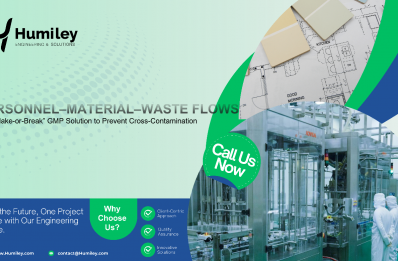
Execution: We map all transfer points: personnel entry/exit, material in, waste out. At each point, we ask: What is the containment measure here? (Airlock? Passbox? Dynamic/Active or Passive?)
Verification: We apply FMEA (Failure Modes and Effects Analysis) to ensure no transfer point is left uncontrolled or unmitigated.
3. Annex 1 gap analysis
Before handover, Humiley performs a structured Gap Analysis against Annex 1 expectations.
Commitment: We cross-check the current design against every requirement across the 16 sections of a CCS template. If we identify any “blank space” (e.g., missing continuous microbiological monitoring at a critical point), we immediately propose equipment additions or design modifications.
At Humiley Group INC, we don’t just deliver a facility—we deliver a robust, defensible contamination control strategy.