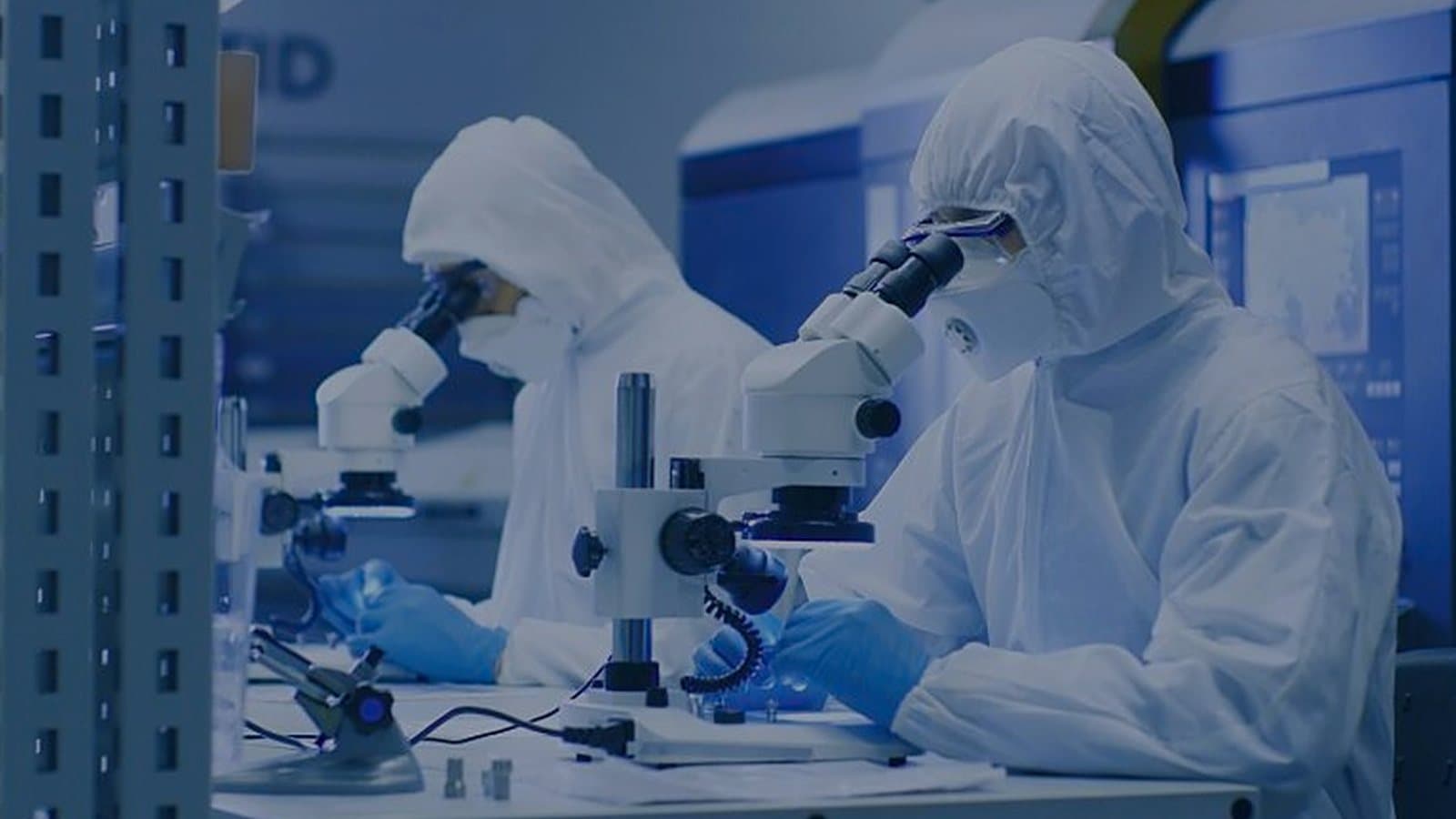
ISO Class 1 allows 10 particles of 0.1 µm and larger per cubic metre; ISO 5 allows 100,000 at that size. At that level the installed leak scan must prove frames and grid, not just the U15 filter, single-digit counts need large sample volumes, and airborne molecular contamination needs its own sampling plan.
HEPA and ULPA filters do not stop airborne molecular contamination, and an AMC limit written only as "1 ppb" is a different mass for every compound: about 0.70 µg/m³ for ammonia, 1.49 µg/m³ for hydrogen chloride. A fab URS should name the compound, the unit with its reference temperature, and the sampling method.
EN 1822 ULPA classes add a nine each above H14: U15 99.9995%, U16 99.99995%, U17 99.999995% at MPPS. Semiconductor ISO Class 1 to 3 spaces need them. A pharma Grade A zone at ISO 5 rarely does, because people and seal leaks drive its counts; H14 with a sound seal usually carries it.
Micro-environments hold ±2% RH at the tool and let the room run a looser band. A 2 m³ enclosure at 0.4 m/s over 1 m² replaces its air every 5 seconds. Steady leakage is the harder case: with the room at 45% ± 5% RH, size the enclosure for 50% RH at the highest room temperature.
Filtration, AMC control, ±2% RH micro-environments and UHP utilities can each drift without an alarm. Designing facility monitoring with them, measuring at the tool, trending utilities and power on one time base and setting alert limits inside action limits, shows drift before the yield report does.
ULPA Filtration & Class 1 Cleanroom Standards: Ultra-Clean Air for Semiconductor Yield Protection In semiconductor manufacturing, even the smallest airborne particle can cause critical defects and significant yield loss. That’s why…