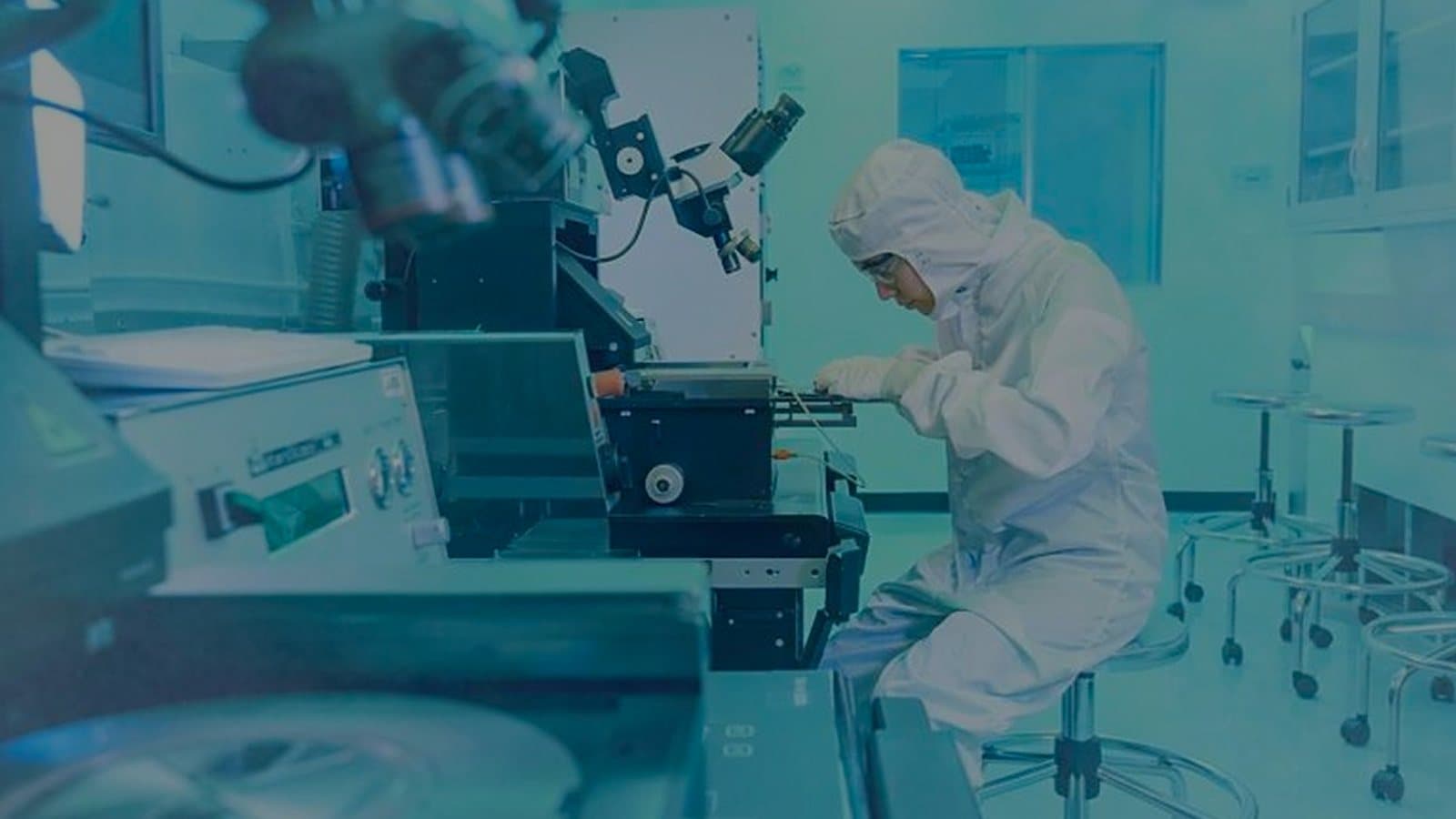
ISO Class 1 allows 10 particles of 0.1 µm and larger per cubic metre. At the same particle size, ISO 5 allows 100,000.
Grade A is ISO 5, and in pharma it is classified at 0.5 µm, where the limit is 3,520. Many cleanroom teams never need the 0.1 µm column of the ISO 14644-1 table. In a fab it is the column that matters, and the gap between ISO 5 and Class 1 there is four orders of magnitude.
Filters are the first consequence. An EN 1822 U15 filter is rated at 99.9995% or better at its most penetrating particle size, but that rating comes from a factory test of the filter element. At Class 1 the installed leak scan has to prove the frames, seals and ceiling grid as well, since a single leaking joint can put a room out of class.
Fabs at ISO Class 1–3 usually run full-coverage unidirectional flow over the process, and the most sensitive steps often sit in micro-environments with their own filtration, so the airflow design follows the tool layout more than the room outline.
Measurement gets underestimated. A counter that resolves 0.1 µm is only the start; seeing single-digit counts with any statistical confidence takes large sample volumes, which means long sampling times at each location. None of it detects airborne molecular contamination, which needs a sampling plan of its own.
Our semiconductor scope covers ISO Class 1–3 and Sub-Class 1 with multi-stage HEPA/ULPA and AMC control.
Industries