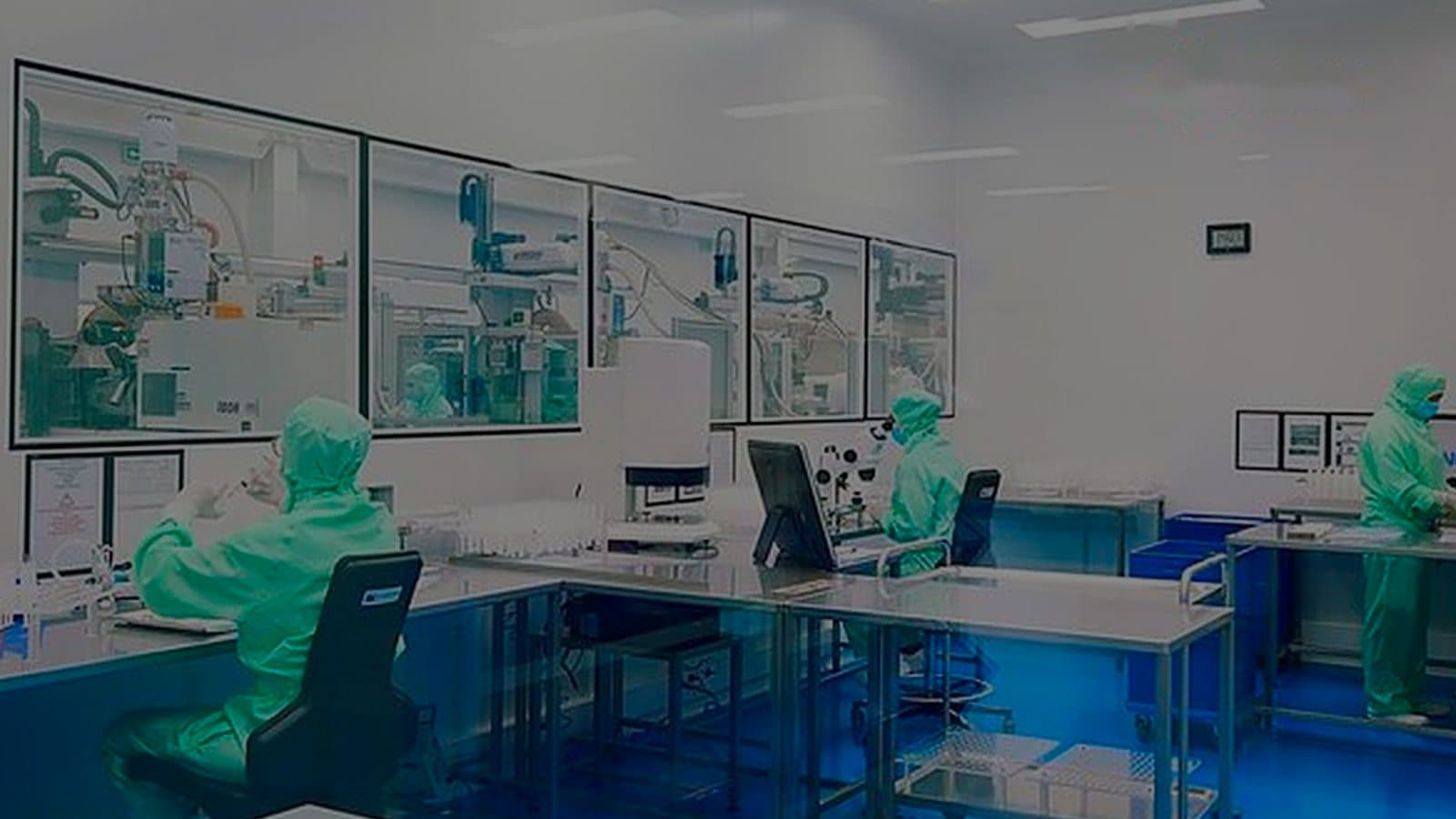
ISO 13485 §6.4.2 asks for documented contamination control without naming a cleanroom class. Setting the class from sterilisation method, patient contact and bioburden sensitivity often lands device assembly at ISO 8, with ISO 7 only where needed, less air than Grade C, a smaller AHU and a reason an auditor can read.
EU GMP Annex 1 (2022) sets maximum requalification intervals: 6 months for Grade A and B cleanrooms and 12 months for Grade C and D. Classification, HEPA leak tests, airflow volume, pressure differentials and air velocity, or recovery where airflow is not unidirectional, are retested. A risk assessment can shorten these intervals, never extend them.
ISO 14644-3 allows installed filter leak scans by aerosol photometer or discrete particle counter. The photometer is quick but needs roughly 10 to 100 mg/m³ upstream; the counter works at far lower loads. For ULPA and filters you want kept free of oil, choose the counter method at design stage.
A photometer leak scan passes a filter when downstream readings stay below 0.01% of the measured upstream concentration. At 20 µg/L upstream the threshold is 0.002 µg/L; a thin challenge pushes it toward the instrument's zero and a real leak reads clean. Reports should state the upstream figure per filter and where it was sampled.
The ISO 14644-3 recovery test times a 100:1 fall in particle concentration after an aerosol challenge and measures the air system. The Annex 1 clean-up period, under 20 minutes as a guidance value and set during qualification, describes the room after real operations. Write the recovery test into the URS and set the clean-up period at in-operation qualification.
21 CFR 211.42 and 211.46 and EU GMP Chapter 3 ask for adequate ventilation, air control and filtration, but give no air change rate or pressure differential, and no filter class beyond HEPA for aseptic areas. Those come from Annex 1, FDA's 2004 aseptic guidance, ISO 14644 and the designer's justification, recorded in the design basis.
ISO Class 1 allows 10 particles of 0.1 µm and larger per cubic metre; ISO 5 allows 100,000 at that size. At that level the installed leak scan must prove frames and grid, not just the U15 filter, single-digit counts need large sample volumes, and airborne molecular contamination needs its own sampling plan.
In a perfectly mixed room, a 100:1 particle reduction takes ln(100) = 4.6 air changes, about 13.8 minutes at 20 ACH. Real rooms take longer because mixing is imperfect. The ISO 14644-3 recovery test measures that gap, so predict it at design stage and fix diffuser and return positions early.
A 50 m² Grade B room needs 10 classification locations under ISO 14644-1:2015, and EU GMP Annex 1 requires them at rest against ISO 5 and in operation against ISO 7, with the smoke study in both states. Whether each run sits in OQ or PQ is for the URS and risk assessment to justify.
EU GMP Annex 1 (2022) sets no ≥5 µm limit for Grade A classification, following ISO 14644-1:2015, but keeps a monitoring limit of 29 per m³ and asks for investigation of repeated low counts. Switching the 5 µm channel off breaks the second rule without anyone noticing.
ISO 14644-1:2015 replaced the square-root rule for classification sampling locations with Table A.1. A 100 m² room went from 10 locations to 16. The revision also dropped the 95% UCL calculation and asks for one location per section of equal area. Requalification plans written before 2016 should be checked against the table.