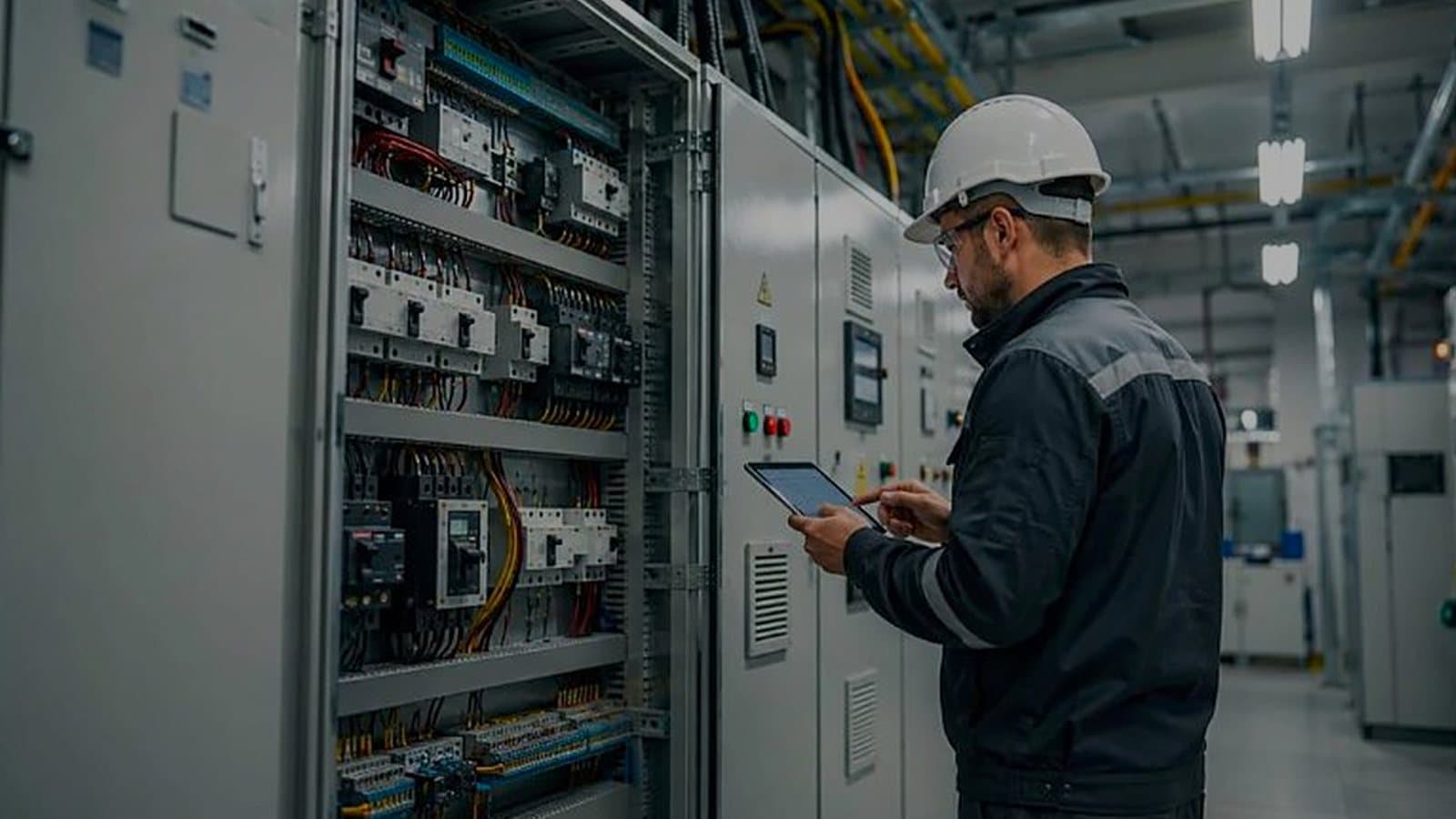
A filter changed on night shift without a leak test turns maintenance into a deviation. GMP maintenance works from criticality bands built on the asset register, planned and corrective work in one system, risk-based requalification and calibration, and 24/7 response across Southeast Asia under a maintenance agreement.
A feeder added to an IEC 61439 board years later has to stay inside the assembly's design verification, or be verified again. Spare ways equipped or prepared in the same system, a busbar sized for the expected extension and clear rules on who may modify the board are cheapest at design stage.
Taking over HVAC maintenance in a running GMP plant starts with four outputs in the first 90 days: a walk-down of every asset behind a GMP parameter, a criticality ranking, the calibration status of every BMS and EMS input, and ownership of open HVAC deviations and CAPAs.
A maintenance contractor's remote view should be read-only, with setpoints changed only under the site's change control. Its alerts watch the plant behind the room, such as fan speed, filter pressure drop and chilled water temperature, and the escalation path to site is written before the contract starts.
At 21 °C and 50% RH, a sensor reading 0.5 K warm reports humidity about 1.5% RH low, most of a ±2% RH band. Wall sensors near doors read their corner, return-duct sensors lag, slow sensors make the loop hunt and drift takes the rest. Sensor position is a design decision.
EU GMP Annex 1 (2022) asks for an integrity test of final filters at requalification and puts no age on the filter. A terminal HEPA is replaced when a leak cannot be repaired within site limits, when pressure drop reaches the manufacturer's final value, or after damage or wetting. On glass-fibre media, dust loading alone does not lower efficiency.
A pressure transmitter above a sealed ceiling with no test connection, a duct probe fixed out of reach, a pipe sensor with no second pocket: each turns calibration into a shutdown or a scaffold job. Test tees with isolating valves, removable probes and spare thermowells cost little on the installation details and save years of postponed calibrations.
The engineering of a retrofit is rarely the hard part. Keeping the rest of the plant in its validated state while the work happens is where these projects are won or lost.