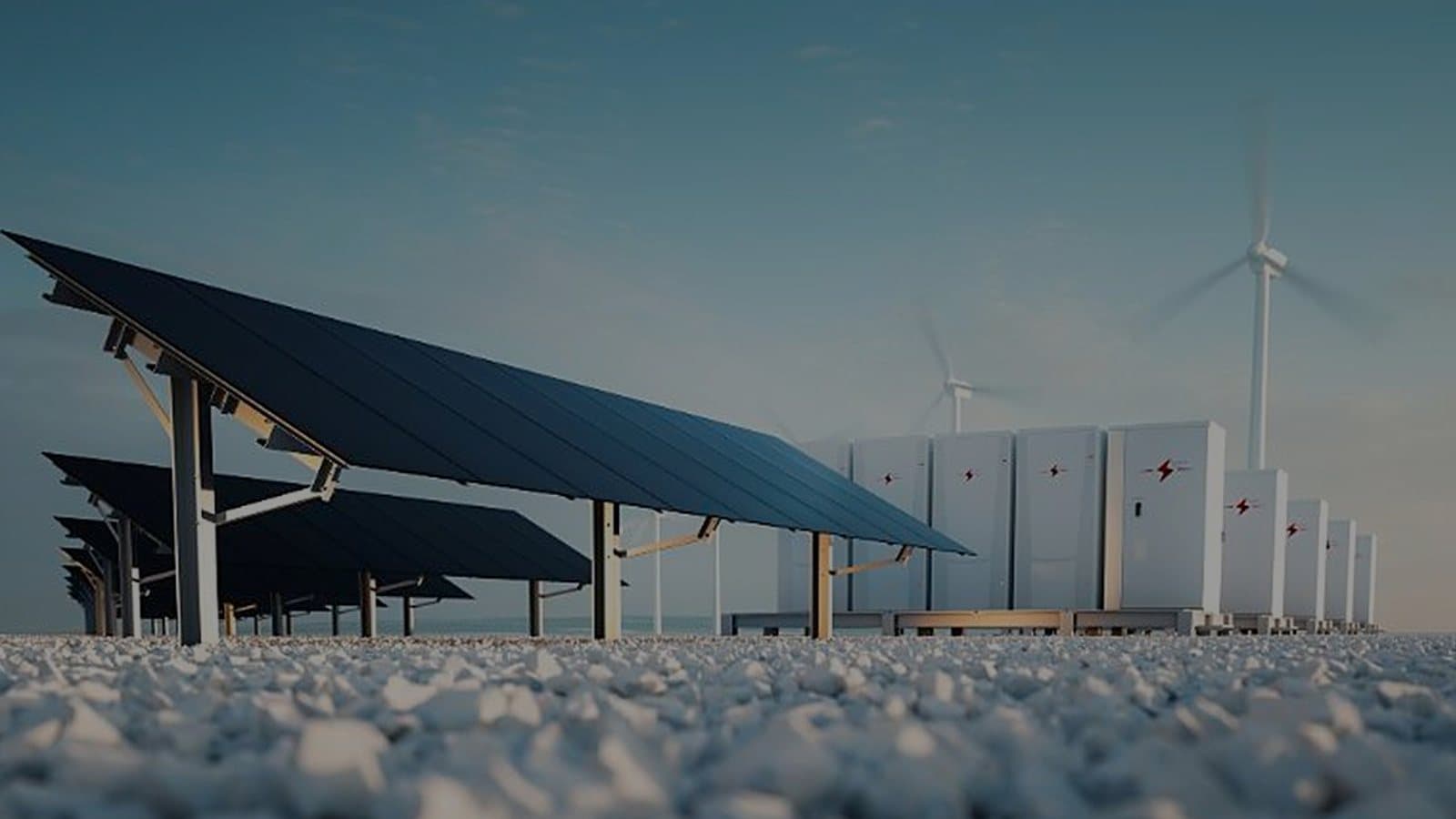
BESS thermal management, gas detection, explosion control and suppression often come from four suppliers, and each changes what the others must handle. Issuing the UL 9540A report with all four packages, naming one interface owner and choosing explosion control from the test data keeps them working as one system.
By ASHRAE's occupant table, light bench work releases about 140 W of latent heat per person, roughly 200 g of water an hour. Ten operators add about 2 kg an hour to a room at −60 °C dew point. Size the dehumidifier on peak headcount, including shift changeover, and write gowning assumptions into the design basis.
A cooling coil dries air only to about its fin temperature; below 0 °C the fins frost. Dry rooms rely on desiccant rotors, down to −60 °C dew point, with a precooling coil removing bulk moisture cheaply first. Where that split sits sets most of the dry room's energy bill.
NMP's lower explosive limit is about 1.3% by volume. Held below 25% of it, an oven evaporating 100 kg/h of NMP needs around 7,500 m³/h of exhaust. The make-up air, its dew point and the coating hall to dry room pressure step should be sized from the same evaporation figure.
At −60 °C dew point a coil would freeze, so a desiccant rotor does the drying and regeneration air, often heated to around 120–140 °C, is the running cost. Pre-cooling ahead of the rotor, heat recovery, staging with the real crew size and a tight envelope are all set at design stage.
In a dual-unit dry-room specification, −60 °C dew point converts to −76 °F with the 32 offset, but a ±2 K tolerance is ±3.6 °F, converted with the 1.8 factor alone. Deadbands and rates of change follow the same rule. Round both columns alike and state which one governs.
At −60 °C dew point and 20 °C, a dry room sits near 0.05% RH. A drift to −40 °C dew point carries about twelve times the water yet reads only 0.55% RH, inside a general-purpose sensor's ±1 to ±2% error. That is why dry rooms are specified and alarmed in dew point.
Opened encapsulant rolls pick up moisture on the layup table, and it can come out in the laminator as voids and later as delamination. Take the film supplier's handling limits as the design input for the layup zone, log RH at the table through a rainy week, and zone stringing to lamination.
Wind-driven rain past a plain louvre soaks the first filter stage of a fresh-air AHU. A 10,000 m³/h intake needs about 1.4 m² of louvre at 2.0 m/s, or 2.8 m² at 1.0 m/s, and the slower louvre admits less water. Add a drained plenum, a cleanable screen and an ISO Coarse first stage.
Hydrogen is flammable from about 4% by volume and pools in roof pockets that a ridge detector cannot see, so electrolyser roofs are detailed without pockets or each pocket is vented and detected, with alarms at 10% and 20–25% LFL. In battery rooms, rack-level off-gas sensing matters for what it switches.
At −60 °C dew point air holds about 0.007 g of water per kilogram, roughly 3,000 times less than outdoor air in southern Viet Nam. By a rough sum, 1 m³/h of leakage uses up around 4,000 m³/h of dry supply air, so the envelope, airlocks and occupancy belong in the dryer specification.