
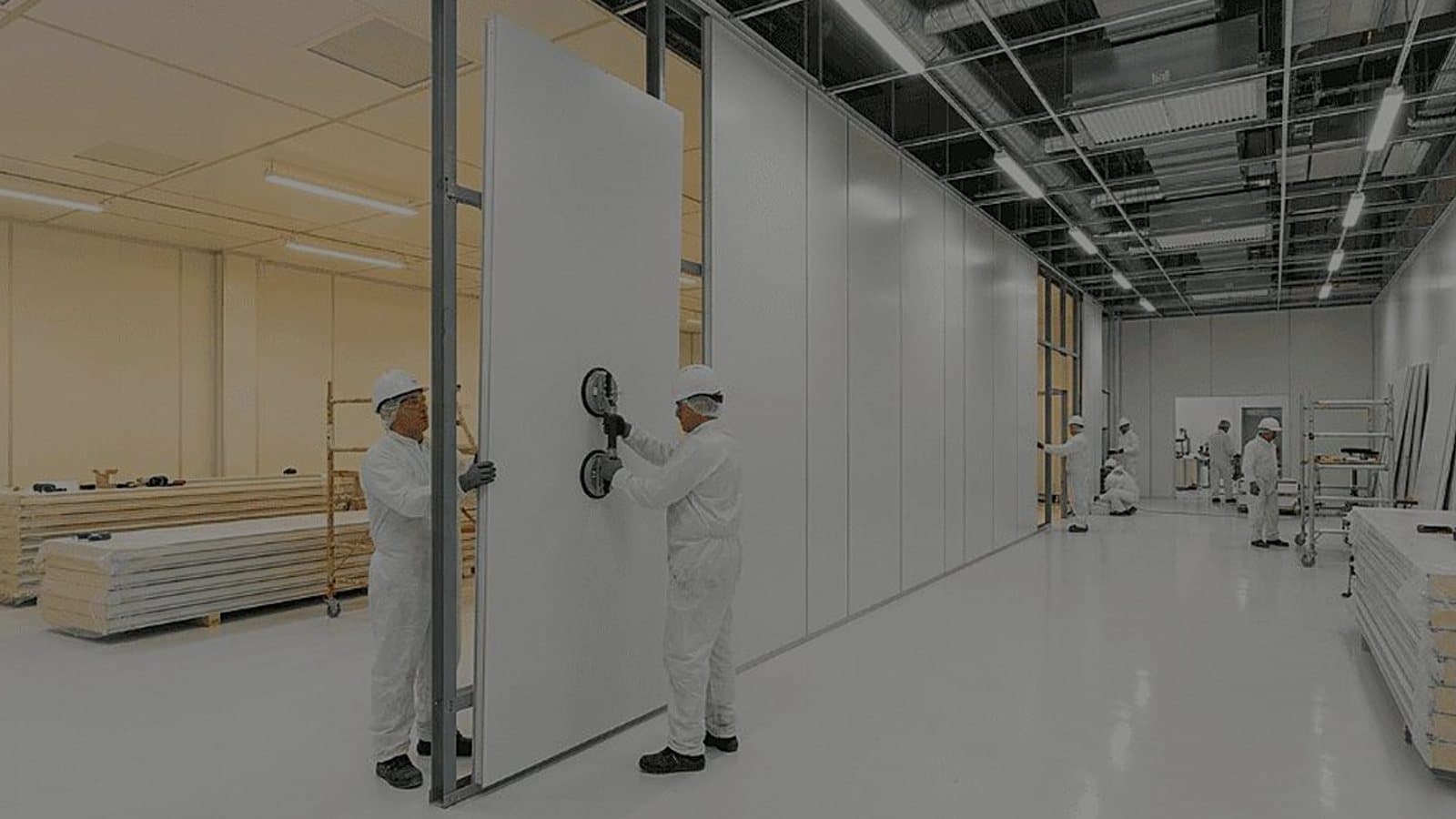
Rock wool, PU or aluminium honeycomb: the panel core decides fire rating, condensation risk and how flat the wall stays.
Panels commonly come in 50, 75 and 100 mm with these three cores, and each answers a different question:
- Rock wool. Non-combustible. The core for walls that form fire compartments or carry a fire-rating requirement. Heavier, and the rating belongs to the tested wall system, not to the core on its own.
- PU. Good thermal performance for its weight. Useful for cold rooms and for walls between conditioned and unconditioned space, where condensation on the wrong face becomes a mould problem. Not the choice for a fire-rated wall.
- Aluminium honeycomb. Flat and stiff. It keeps the face true over height, which matters where flush-glazed windows, doors and pass boxes sit in the wall.
Thickness then follows practical limits: services routed inside the wall, unsupported span, and the frame depth of doors and windows that have to finish flush.
Cleanability is decided more by details than by the core. Flush joints with no ledges, coved corners, sealed penetrations, door leaves flush with the wall face. Every ledge is a place where particles settle and a cleaning operator misses.
Cleanroom panels, doors and modular walls are part of our equipment range, built by qualified partners under Humiley engineering control.
Where do you put the flush-glazed windows when the wall has to be rock wool?
Topics

