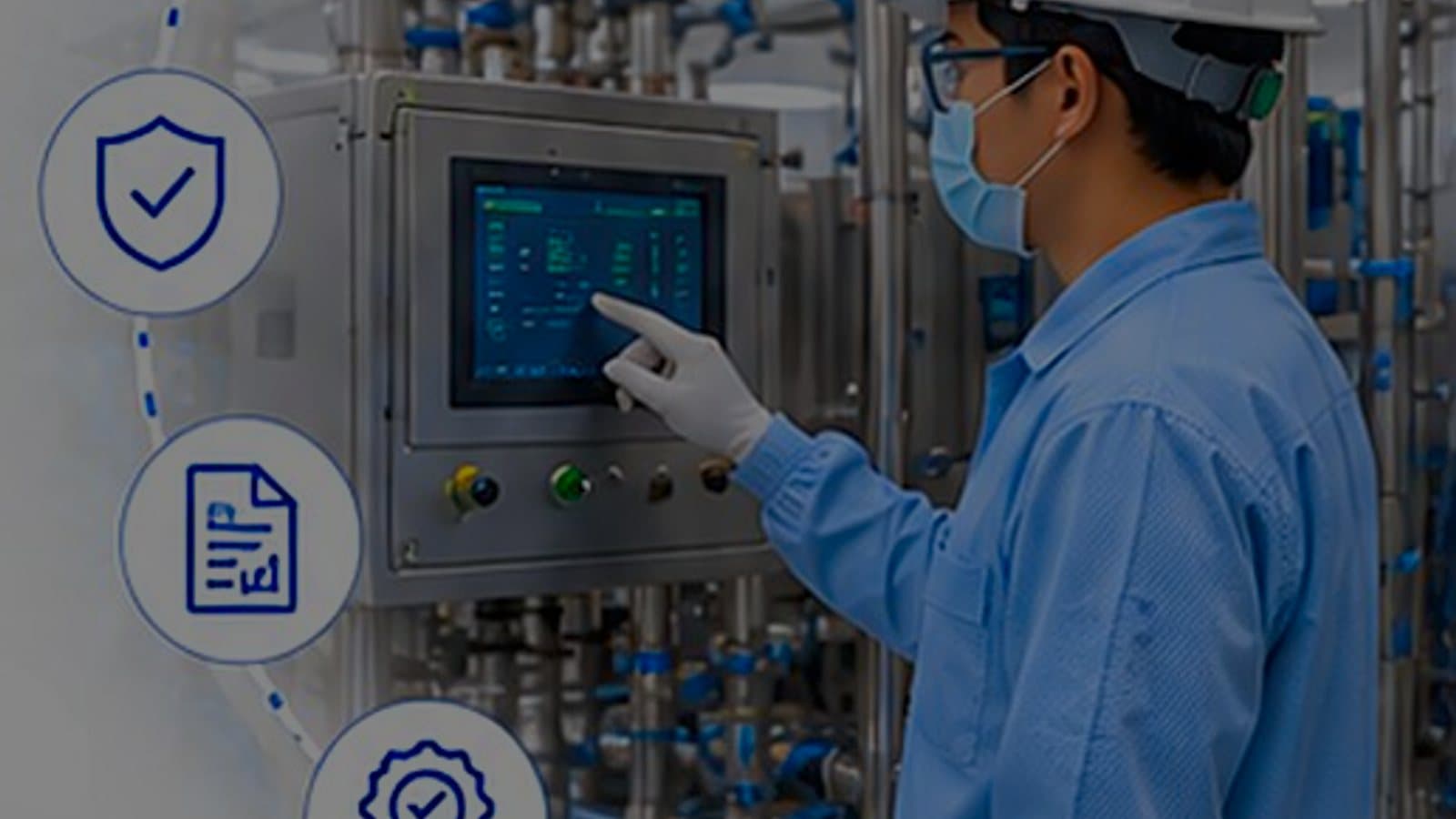
Environmental monitoring and BMS data that support GMP decisions must meet ALCOA+. In practice that means individual logins, time-synchronized controllers, an audit trail users cannot disable, alarms acknowledged with name and comment, and tested backups, with GMP-critical parameters separated early onto a validated system.
At 21 °C, 45% RH needs supply air near an 8.6 °C dew point; 55% RH needs about 11.6 °C. That 3 K is paid at the coil and in reheat every hour. Write each RH band from product data with its reason, and keep tight-band rooms off the AHU that serves the rest.
URS, DQ, IQ, OQ and PQ are drawn as a sequence, but every test on the right of the V-model depends on a measurable requirement on the left. Writing the URS before concept design and starting the traceability matrix on day one turns late site changes into early drawing changes.
EN 1822 rates H13 at 99.95% and H14 at 99.995% efficiency at MPPS. H14 earns its cost over open product in Grade A and on scan-tested terminal filters. In well pre-filtered Grade C and D rooms, H13 usually suffices, and a poor seal defeats either class.
A 10–15 Pa differential between grades exists only while the door is shut. Once it opens, door swing, the operator's wake and any temperature difference between rooms drive air both ways. Holding adjacent rooms at the same temperature, keeping door-open time short and interlocking airlocks keep the exchange small.
Under EU GMP Annex 1 (2022), the Contamination Control Strategy has to connect barriers, airflow, personnel and material flows, cleaning, utilities and monitoring. A useful test for any CCS: every line should point to a drawing, calculation or test, not to a procedure written after construction.
Designer, supplier, contractor and maintenance team each hold part of a facility's design intent, and assumptions get lost at every boundary. Humiley works as four divisions on one design basis, so the drawing, the factory acceptance test and the maintenance plan all trace back to the same requirements.
As we stand at the threshold of 2022, Humiley Group INC takes this moment to reflect on our journey and the steadfast values that guide our work in the pharmaceutical and semiconductor sectors. We begin this new year with a renewed pledge…
Precision in Practice: 3D Design in Pharmaceutical Projects. In pharmaceutical projects, 3D design is more than visualization — it is a foundation of compliance. In GMP-regulated environments, design decisions directly affect safety,…
In pharmaceutical facilities, contamination control is not defined by room classification alone — it is defined by how flows interact. Even a facility that meets cleanroom classification requirements can face GMP risks if critical flows…
A cleanroom can meet its classification on paper, yet fail GMP expectations if HVAC performance is unstable or poorly aligned with operational reality. Cleanroom performance is often discussed in terms of ISO classes or GMP grades.
In pharmaceutical facility design, if the HVAC system is the "lungs," then the Zoning and Pressure Cascade strategy is the "immune system." It creates invisible but effective barriers that prevent microbial ingress and strictly control…