A desiccant wheel sized for wet-season fresh air can over-dry a tight-band room in the dry season. At 21 °C and 30% RH, ±2% RH is a dew point window about 2 K wide. Specify reactivation-heat turndown to the dry-season load, a second control lever, and check the band in both seasons.
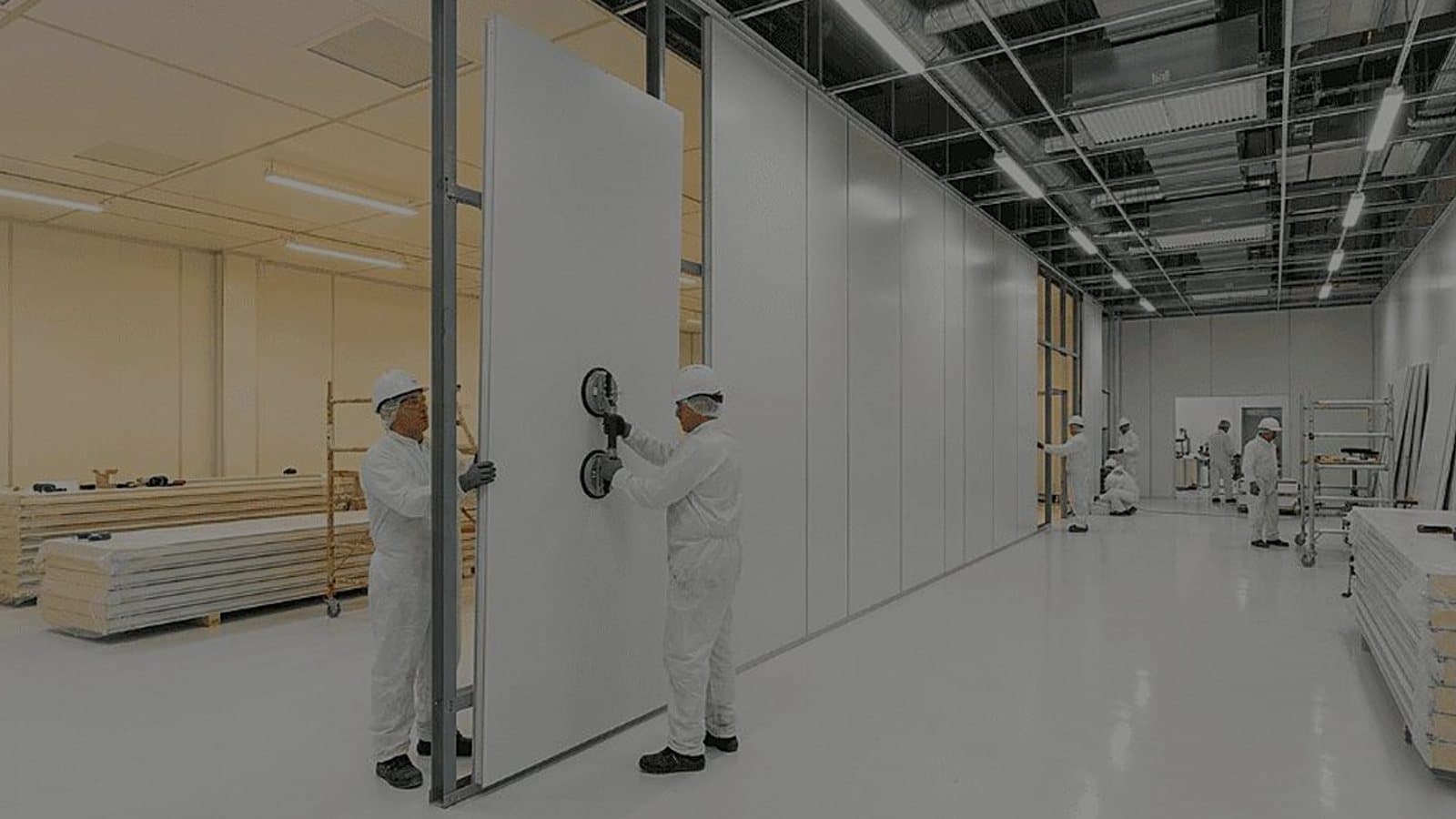
Rock wool, PU and aluminium honeycomb cores in 50, 75 and 100 mm panels each answer a different requirement: fire rating, thermal performance or flatness. Thickness follows services, span and door frame depth, while cleanability depends on flush joints, coved corners and sealed penetrations.
A new AHU started during construction loads its coil, drain pan and final filters with site dust that does not vacuum off wet fins. Clean the casing before power-on, seal duct openings, run on temporary pre-filters, fit final filters after the final clean and record it for IQ.
Duct leakage, cascade balance, controls tuning and recovery can only be measured once an AHU is connected on site. A FAT can still speed up those tests by recording clean filter and coil pressure drops, the casing leakage result, fan airflow at design static and the panel software version with its I/O list.
The sequence of operation decides what a cleanroom does on restart, on a trip and in a power cut. QA usually meets it at OQ, when every change costs a software revision and a retest. Walk it line by line with QA and maintenance before panels are built: start order, trips, alarm delays and fail positions.
A catalogue AHU suits an office zone or a like-for-like swap. Where humidity is specified it needs checking: a room at 20 °C and 45% RH has a dew point of about 7.7 °C, and a range coil can meet total kW yet leave the air wetter. Ask for leaving-air dew point at the site's peak condition.
Replacing an AHU in a running facility starts with as-found readings: terminal airflows, pressures across the cascade, temperature and RH. They are the balancing target for the new unit and the evidence that the qualified state returned. Decide with QA beforehand whether to balance to design or to as-found.
A square internal corner in a cleanroom holds residue and denies disinfectant its contact time. Coved junctions fix that, but only if the joint between cove profile and panel is flush and sealed. Agree the detail on a drawing and check the radius against the tool the cleaners actually use.
A 900 mm cleanroom door with a 5 mm undercut leaks about 50 m³/h at 15 Pa, and about 100 m³/h at 10 mm. Door gaps set how much offset air holds a 10–15 Pa cascade. Specify door leakage as a number at a stated pressure, with the test, and check it before installation.
Substitutions reach site through vendor drawings approved in a hurry. Before releasing fabrication, check the duty point at design conditions, materials in the air path, clearances against the BIM model, sensors against the BMS I/O list, and the certificates and FAT procedure that must come with the unit.
Heat tint is removed by pickling or mechanical cleaning, then passivation restores the oxide layer, and a treated part looks like an untreated one. The only proof is the record made at the time: procedure, chemical, contact time, date, operator and check. Collected during production, it means IQ starts from a complete file.