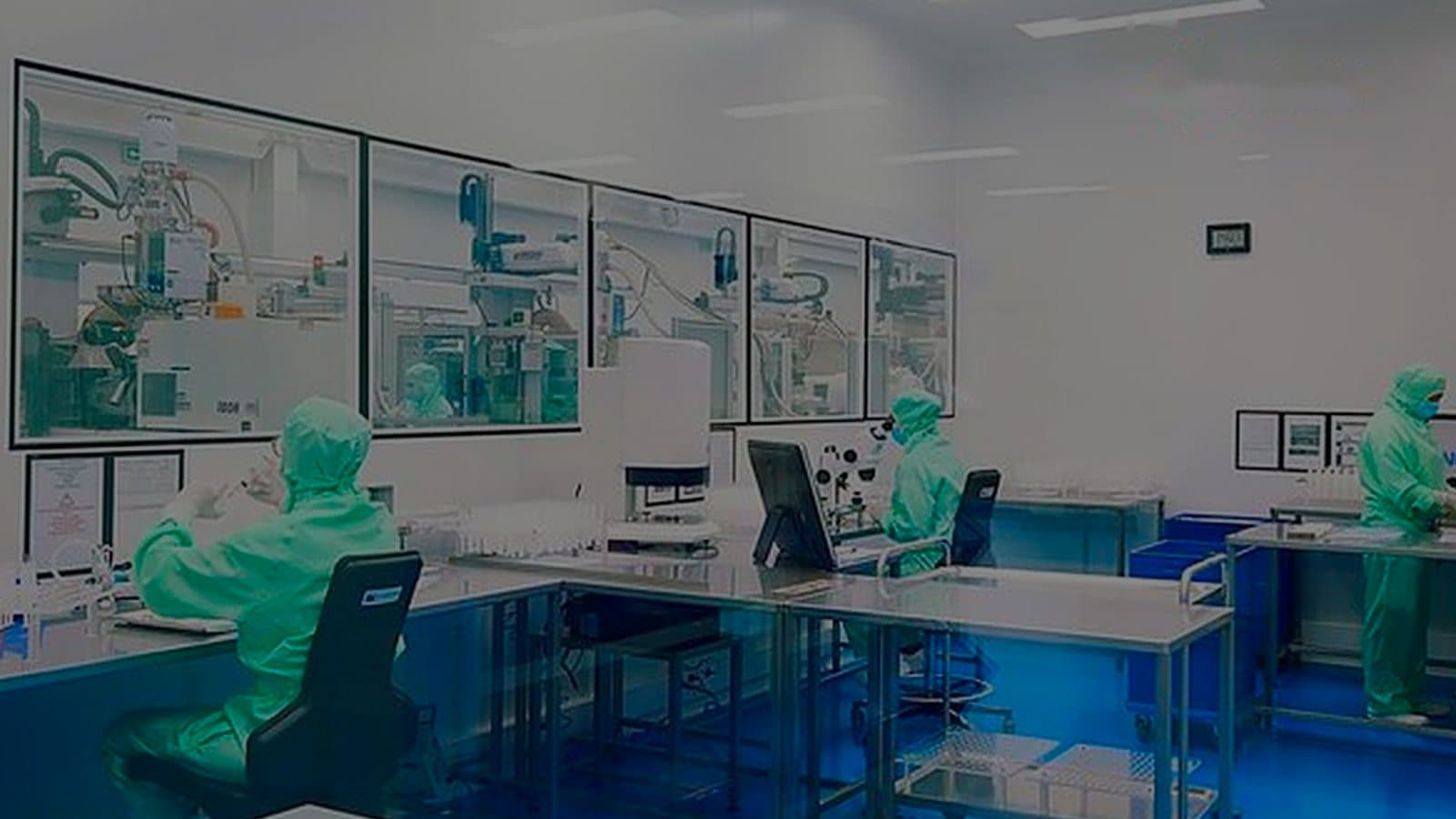
Tony Nguyen asks clients to test Humiley's younger engineers at design reviews with one question: what does the room do when the door opens? A Grade C room drawn 15 Pa above its corridor loses that difference with the door open. A good answer covers outflow through the doorway, the alarm delay and the recovery test.
In a Li-ion dry room at −60 °C dew point and below, extra air changes do not help: return air often passes back through the desiccant rotor, so more supply air means a bigger rotor and more regeneration heat. Size airflow from the moisture balance; pressure control, airlocks and envelope sealing carry over from pharma.
A decontamination room can read negative on the BMS while its return air mixes with the packing room's in a shared ceiling void. ASHRAE 170 expects the room negative, at least 6 air changes per hour and all air exhausted outdoors. That needs an exhaust ducted all the way outside and a working washer-disinfector door interlock.
A fume hood draws room air in at around 0.5 m/s. Cross-drafts from nearby diffusers, doors and walking routes above about half that pull vapour out past the sash, whatever the factory test said. Lay out supply, hoods and makeup air to that number, then prove it with an as-installed test.
In EU GMP Annex 1 (2022), 3,520 particles of 0.5 µm and larger per m³ is both the Grade A classification limit and the Table 5 monitoring maximum. In a 28.3 L sample that is about 100 counts, and one count reads as about 35 per m³, so site alert levels are clearer written as counts per sample.
A contamination control strategy spread across dozens of documents is hard to present in one inspection day. A storyboard with one page per risk, carrying design controls, SOP references, monitoring trends, the owner and open CAPAs, gives the team a way to walk an inspector through it without rewriting the strategy.
In cell and gene therapy, an open step needs Grade A air, usually in a Grade B background with the gowning and air volumes that come with it. A proven closed process can justify a lower background grade. Map every step that opens the product before fixing room grades and HVAC size.
In a potent-compound suite, open powder handling makes the room the primary containment; an isolator or closed transfer moves most of it to the equipment. Write the exposure limit into the URS in µg/m³, not only the OEB band, and ask for surrogate powder test data to set against it.
Annex 1 leaves Grade B particle monitoring frequency and sample size to the site. A sequential counter with 8 one-minute ports revisits each point about every 8 minutes, so a 3-minute event can be missed. Set locations from the smoke study, frequency from the events, and justify both in the CCS.
One fume hood with a 1.8 m sash open 0.5 m at 0.5 m/s exhausts about 1,620 m³/h, or 9 air changes an hour in a 180 m³ lab. Variable-volume hoods save energy when sashes close, but their tracking has to be tested by failing a sensor at commissioning.
The scope of EU GMP Annex 1 (2022) says some of its principles, including the contamination control strategy, may be used for certain non-sterile products such as liquids, creams and ointments. A semi-solids plant that writes a CCS tying room grades, flows, water and monitoring to product risk has an answer for the inspector.