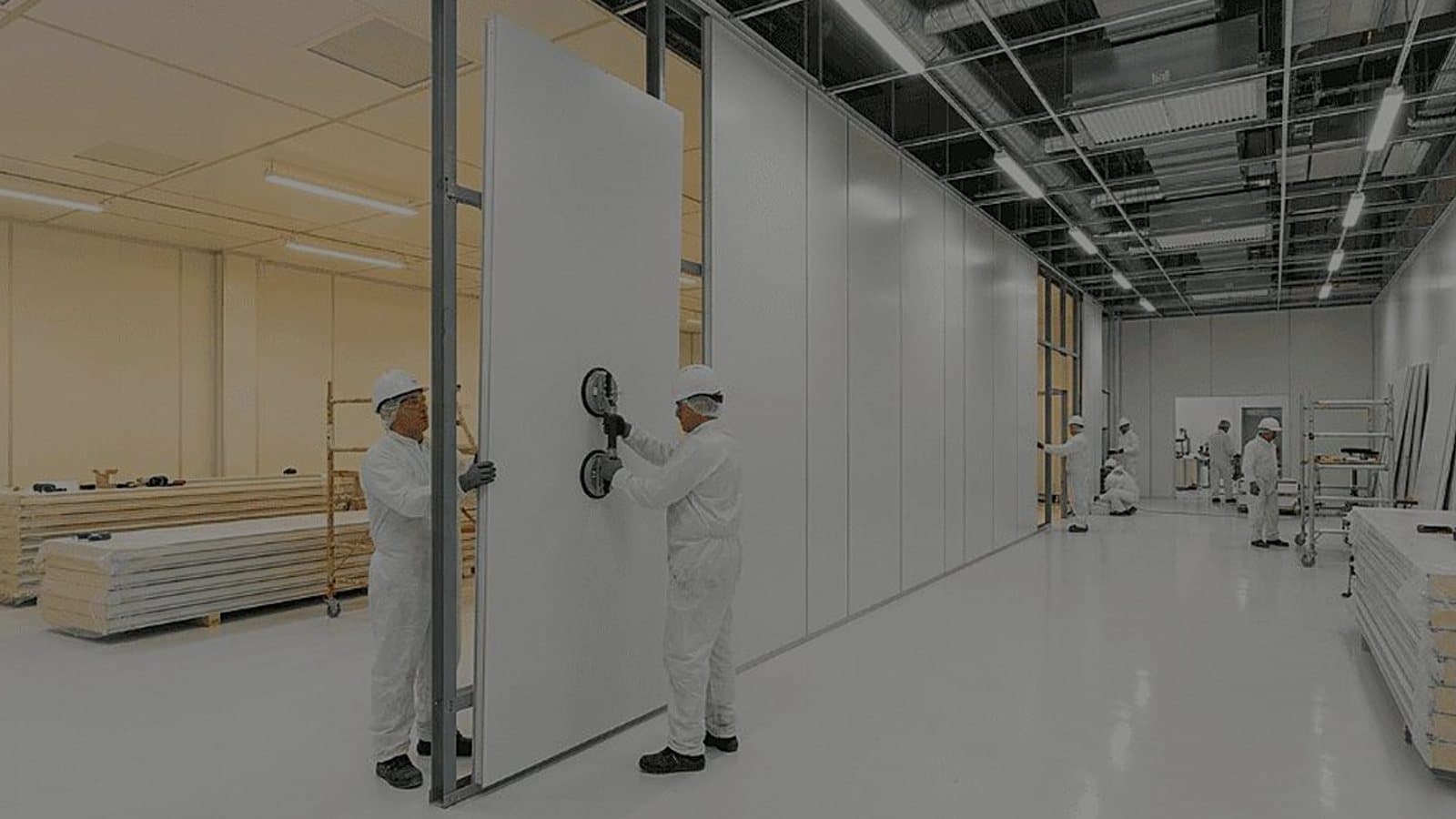
New slabs, screeds and plaster release water into the room for weeks after the HVAC starts. Tuning controls or running OQ humidity tests through that load measures the building drying out. Plan a dry-out period, trend RH and dew point daily, and start humidity OQ once the trend flattens.
Nameplate kW is maximum electrical input. Heat released to a cleanroom depends on duty cycle, ducted exhaust, process cooling water and product. A 10 kW oven at 50% duty with half its heat ducted away adds about 2.5 kW. Summing nameplates oversizes coils and hurts dew point control at part load.
Recirculated cleanroom air returns near room condition and needs almost no dehumidification. In a worked wet-season example, 10,000 m³/h of fresh air costs about 186 kW of coil load. Remove avoidable fresh air from exhaust, leakage and over-pressurisation before investing in heat recovery devices.
When the fresh-air unit does all the drying and room AHU coils stay dry, every room's humidity depends on that one unit. Size its coil on the wet-season coincident condition, control on off-coil dew point, and decide in the design basis what happens when it trips.
In the wet season, outdoor air at 29 °C and a 26 °C dew point carries about 84 kJ/kg, against about 37 kJ/kg for cleanroom return air at 20 °C / 45% RH. Economiser hours are close to zero; tropical savings come from dehumidification strategy, avoided reheat, fan power and chiller lift.
A 20 °C / 45% RH room has a dew point near 7.7 °C. A recirculation coil on 12 °C water stays dry; on 6 °C water it condenses, dehumidifies against the fresh-air unit and needs a wet drain pan. The dry coil is larger and needs a second water temperature.
Mapping protocols from temperate countries ask for summer and winter studies. In southern Viet Nam the real extremes are the hot dry months, which test temperature, and the rainy season, which tests humidity and latent cooling load. Two mappings timed to the local calendar give an inspector a record worth reading.
A chilled-water valve with 10 kPa across it on a 40 kPa coil branch has an authority of 0.2. At part load it sits near its seat, hunts, and the cleanroom dew point swings. Size the valve drop close to the branch drop, aim near 0.5, and check the opening at minimum load.
Bringing 10,000 m³/h of outdoor air from 29 °C / 26 °C dew point to 10 °C / 9 °C dew point takes about 186 kW of cooling, two-thirds of it condensing roughly 170 kg of water an hour. Fresh-air and exhaust quantities deserve the same scrutiny as filter grades.
Before the supply fan is selected, check whether the coil sheet quotes a wet or a dry air pressure drop, and read it with the entering condition: dry- and wet-bulb at the peak dew point case. Then check leaving dew point against room RH, face velocity below about 2.5 m/s and a realistic chilled-water ΔT.
Drying 10,000 m³/h of wet-season air from a 26 °C to a 9 °C dew point removes about 170 kg of water an hour, roughly 4 m³ a day at full load. The condensate is low in minerals and a candidate for reuse such as cooling tower make-up, after a site assessment.