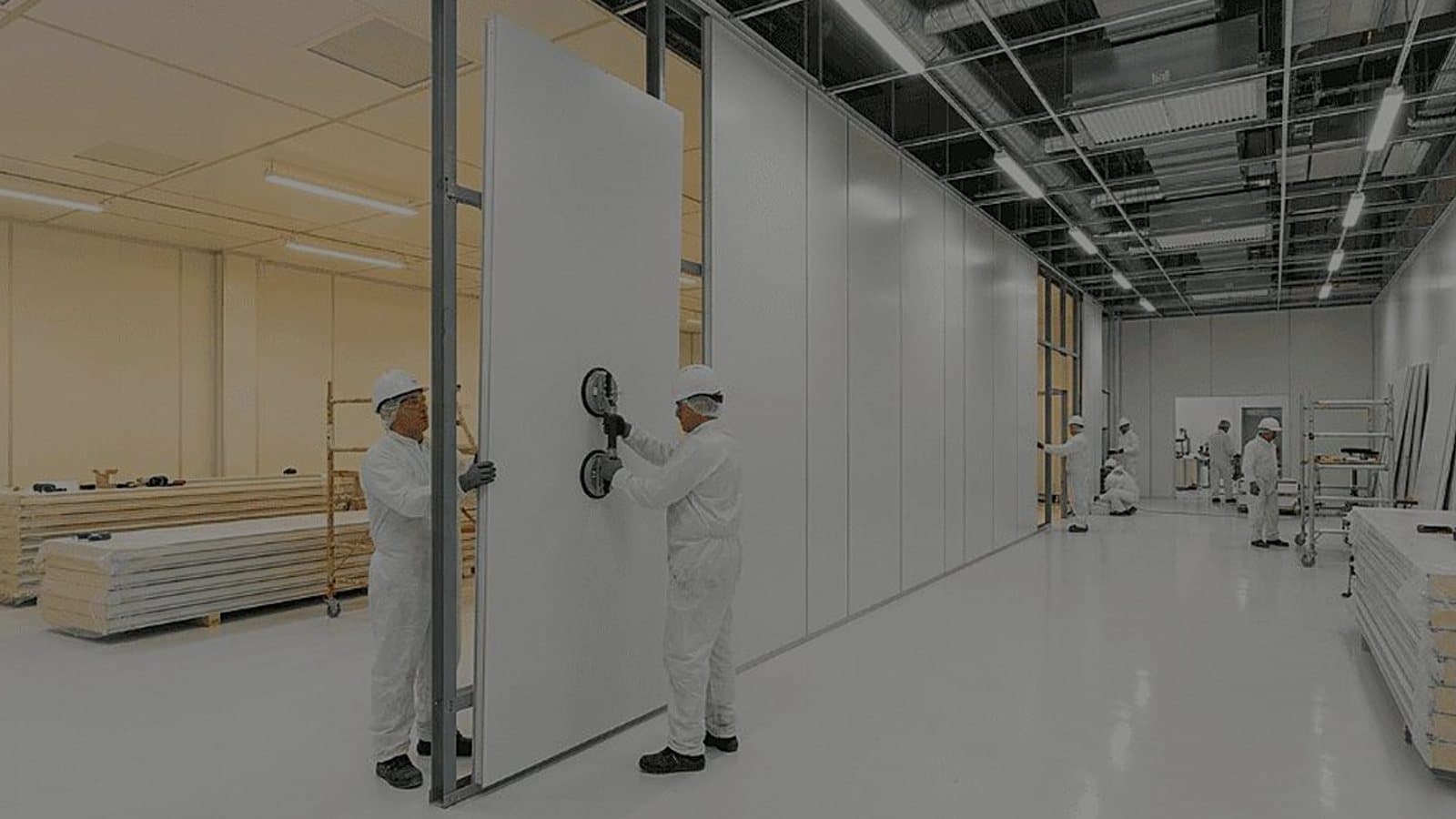
Six discipline models in one BIM file can still be issued on six dates, and every clash in the ceiling void then becomes an RFI. Splitting the void into zones, each with a clash register that includes soft clashes and is signed by every discipline lead before issue, keeps them in the design office.
Electric reheat is paid for twice, as heat and as the cooling that removed it. A wrap-around heat pipe reheats with no energy input but adds pressure drop: 100 Pa at 5 m³/s and 60% fan efficiency is about 833 W, every running hour. The comparison is a per-unit calculation.
New slabs, screeds and plaster release water into the room for weeks after the HVAC starts. Tuning controls or running OQ humidity tests through that load measures the building drying out. Plan a dry-out period, trend RH and dew point daily, and start humidity OQ once the trend flattens.
Recirculated cleanroom air returns near room condition and needs almost no dehumidification. In a worked wet-season example, 10,000 m³/h of fresh air costs about 186 kW of coil load. Remove avoidable fresh air from exhaust, leakage and over-pressurisation before investing in heat recovery devices.
In the wet season, outdoor air at 29 °C and a 26 °C dew point carries about 84 kJ/kg, against about 37 kJ/kg for cleanroom return air at 20 °C / 45% RH. Economiser hours are close to zero; tropical savings come from dehumidification strategy, avoided reheat, fan power and chiller lift.
Mapping protocols from temperate countries ask for summer and winter studies. In southern Viet Nam the real extremes are the hot dry months, which test temperature, and the rainy season, which tests humidity and latent cooling load. Two mappings timed to the local calendar give an inspector a record worth reading.
Bringing 10,000 m³/h of outdoor air from 29 °C / 26 °C dew point to 10 °C / 9 °C dew point takes about 186 kW of cooling, two-thirds of it condensing roughly 170 kg of water an hour. Fresh-air and exhaust quantities deserve the same scrutiny as filter grades.
Pure steam at 3 bar(g) saturates near 144 °C; at 3 bar(a), near 134 °C. A 134 °C sterilizer cycle needs about 3.04 bar absolute in the chamber, so a generator quoted at 3 bar absolute cannot reach it. Write the gauge or absolute suffix on every utility pressure.
A selection program will size a coil for any input, including a wrong one. Engineers who have worked the psychrometric chart by hand notice when an answer is off. Humiley's training pairs fundamentals with on-the-job work on real project packages, mentored by senior leads, starting from a 12-month internship.
Voltage distortion is harmonic current multiplied by source impedance. An EC fan wall draws the same harmonic current on grid or generator, but a transformer is typically 4–6% impedance and a generator's subtransient reactance typically 12–20%. Model both sources and set a distortion limit for the busbar on standby power.
At 50% airflow the cube law gives a fan 1/8 of its full-flow power, but the motor is then at about 25% of rated torque and away from its nameplate efficiency. Ask for motor and drive losses, or EC fan input power, at the setback point and list it on the fan schedule.