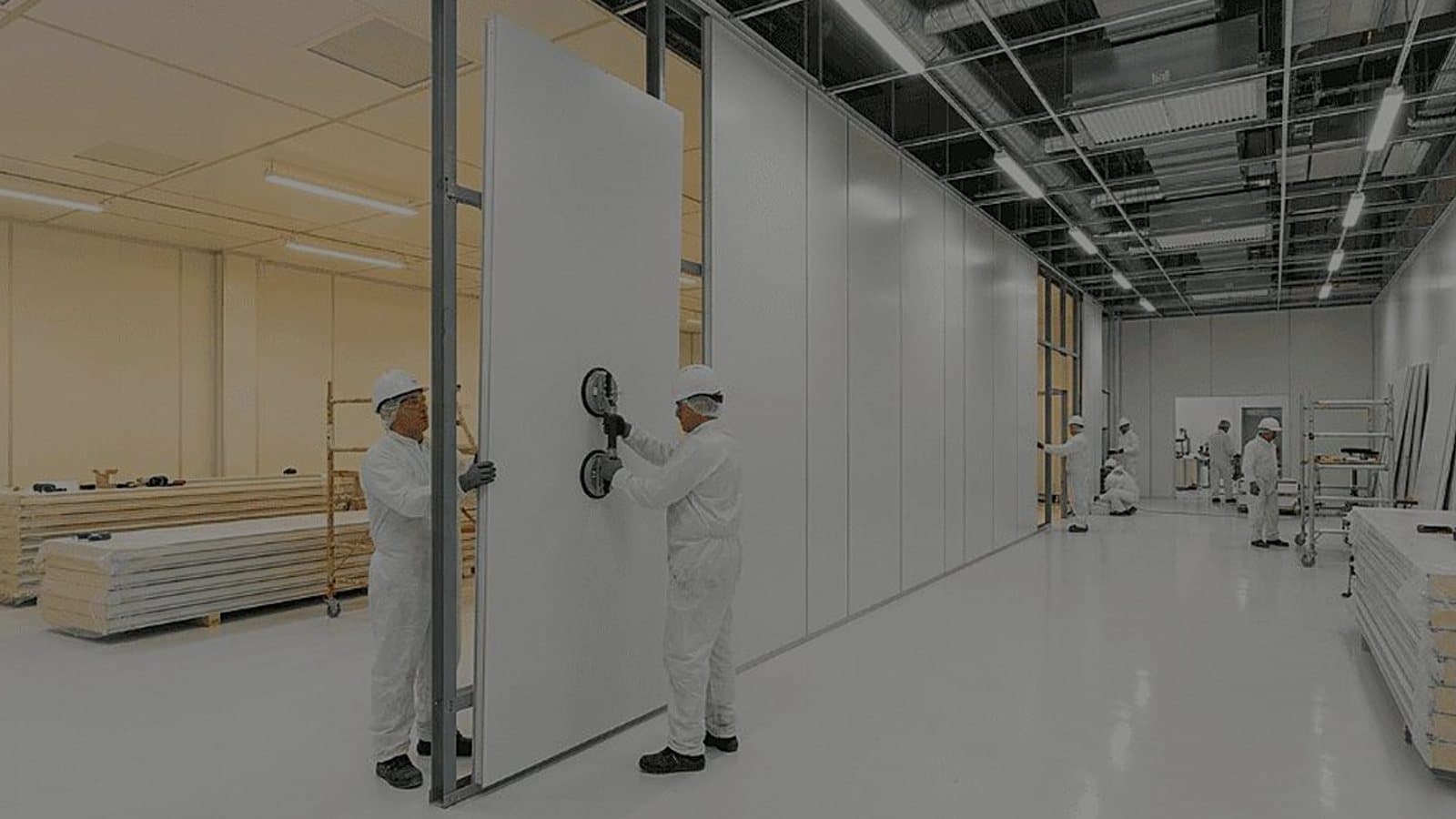
Air in a ceiling void has never passed a HEPA filter. If the void sits above room pressure, leaks bring it down past light frames and HEPA collars. Keep one void at or below the lowest room under it, seal duct joints, and measure room-to-void pressure at commissioning.
Raising a 6 × 5 m room from 3.0 m to 3.5 m drops 1,800 m³/h from 20 to 17.1 air changes. The in-operation particle count barely moves, because steady-state concentration depends on generation and supply airflow, not volume. Recovery takes about 17% longer. Restoring 20 ACH needs 2,100 m³/h.
A 3 m cleanroom at 100 W/m² and an 8 K supply difference needs about 12 ACH for cooling. If cleanliness sets 40 ACH, the other 28 are dilution air. Moving it through the central AHU costs fan energy; a recirculation loop or FFUs can move it at lower pressure.
A probe with a 3 cm opening moving at 5 cm/s sits over any point for 0.6 seconds; triple the speed and it is 0.2. Frame leaks give thin, diluted plumes that a fast pass misses. Calculate the scan rate for the probe and instrument, overlap the strokes, and scan the perimeter separately and slowly.
A filter change record needs the isolation details, how the old filter was bagged, a frame and gasket check, ΔP before and after, and the leak-test decision. A terminal HEPA that is replaced or disturbed gets an installed leak test before the room returns to use.
ISO 29463 labels encode efficiency: ISO 35H is at least 99.95% and ISO 45H at least 99.995%, the integral efficiencies of EN 1822 H13 and H14. ISO 40H sits between them with no EN 1822 name and passes twice as many particles at MPPS as 45H. Name the accepted equivalent in the specification.
EN 1822 classifies a filter at its rated airflow. Above it, pressure drop rises roughly in proportion to media velocity, diffusion capture falls and the most penetrating particle size shifts smaller. A filter classed H14 at nominal flow may not reach H14 efficiency at 120% of it.
Under EN 1822, every filter from H13 upwards is tested individually and ships with its own report. At receiving, match class, serial number, rated airflow and result on label and report, then record each serial against its ceiling position in the IQ so a later leak-test failure can be traced to its lot.
EN 1822 classes the filter, not the medium. PTFE membrane usually reaches a HEPA class at lower pressure drop and handles better than brittle glass fibre, but its surface catches oil aerosol from leak tests. Agree the test aerosol with the filter maker before specifying PTFE for pharma rooms.
A walk-on cleanroom ceiling turns the void into a service floor, so dampers, sensors, cables and lighting are maintained without entering the room. It only helps filter changes if the HEPA housings are top-serviceable, and the void must be designed as a floor. Worth it for plant-heavy suites, rarely for small labs.
A shared exhaust duct spreads a solvent's hazardous zone, cakes process dust in humid air, carries potent-compound contamination through the building if joined upstream of the HEPA, and moves fume-hood face velocity with other dampers. Draw each stream with its hazard, treatment and fan first.
EN 1822 rates HEPA filters at the most penetrating particle size, typically 0.1–0.25 µm for glass-fibre media, while US practice quotes 99.97% at a fixed 0.3 µm. Because 0.3 µm is above the MPPS, the two numbers come from different tests and cannot be compared line by line on a datasheet.