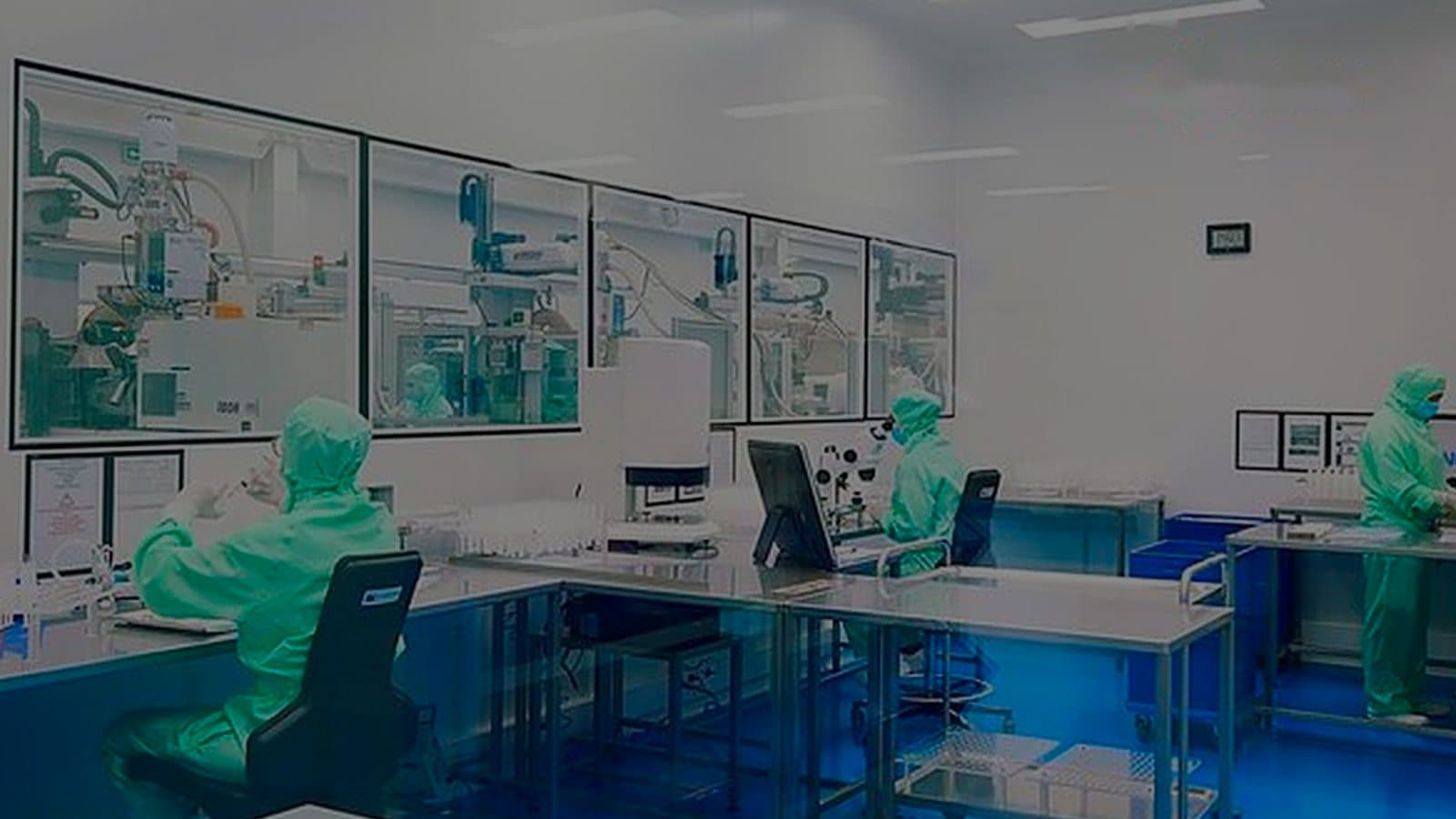
Grade B must meet ISO 5 at rest (3,520 particles ≥ 0.5 µm/m³) but only ISO 7 in operation (352,000/m³). The hundredfold allowance covers the line running and people at work, and people are the larger source. Size airflow for the real headcount, set the clean-up period, treat gowning as a control and monitor where people work.
ISO 13485 §6.4.2 asks for documented contamination control without naming a cleanroom class. Setting the class from sterilisation method, patient contact and bioburden sensitivity often lands device assembly at ISO 8, with ISO 7 only where needed, less air than Grade C, a smaller AHU and a reason an auditor can read.
EU GMP Annex 1 (2022) sets maximum requalification intervals: 6 months for Grade A and B cleanrooms and 12 months for Grade C and D. Classification, HEPA leak tests, airflow volume, pressure differentials and air velocity, or recovery where airflow is not unidirectional, are retested. A risk assessment can shorten these intervals, never extend them.
EU GMP Annex 1 (2022) gives WFI circulation above 70 °C as an example of minimizing the risk of microbial growth. Keeping a loop hot drives the design: ASME BPE dead legs of L/D ≤ 2, turbulent flow to the last user point, planned sanitization and sensors on the return. The CCS should justify all of it.
High-purity PVDF joined like ordinary plastic pipe leaves fusion beads that trap bacteria, so fab UPW loops use bead-and-crevice-free joints. UHP gas lines add electropolished 316L, orbital welds with coupons, helium leak tests and outlet particle, moisture and oxygen checks. Pharma WFI practice shares much of the discipline.
A square internal corner in a cleanroom holds residue and denies disinfectant its contact time. Coved junctions fix that, but only if the joint between cove profile and panel is flush and sealed. Agree the detail on a drawing and check the radius against the tool the cleaners actually use.
Tony Nguyen asks clients to test Humiley's younger engineers at design reviews with one question: what does the room do when the door opens? A Grade C room drawn 15 Pa above its corridor loses that difference with the door open. A good answer covers outflow through the doorway, the alarm delay and the recovery test.
ISO Class 1 allows 10 particles of 0.1 µm and larger per cubic metre; ISO 5 allows 100,000 at that size. At that level the installed leak scan must prove frames and grid, not just the U15 filter, single-digit counts need large sample volumes, and airborne molecular contamination needs its own sampling plan.
Leakage through room gaps rises with the square root of pressure at best, so going from 10 to 20 Pa adds about 41% leakage air, nearer 57% through real cracks. Annex 1 guidance is at least 10 Pa between grades; a room set higher should have its reason in the design basis.
A 50 m² Grade B room needs 10 classification locations under ISO 14644-1:2015, and EU GMP Annex 1 requires them at rest against ISO 5 and in operation against ISO 7, with the smoke study in both states. Whether each run sits in OQ or PQ is for the URS and risk assessment to justify.
EU GMP Annex 1 expects the final stage of an airlock to be, at rest, the same grade as the cleanroom it leads into. Into Grade B, that means 3,520 particles of 0.5 µm per m³, terminal HEPA supply, its own pressure step and a place in environmental monitoring, not a transfer grille.