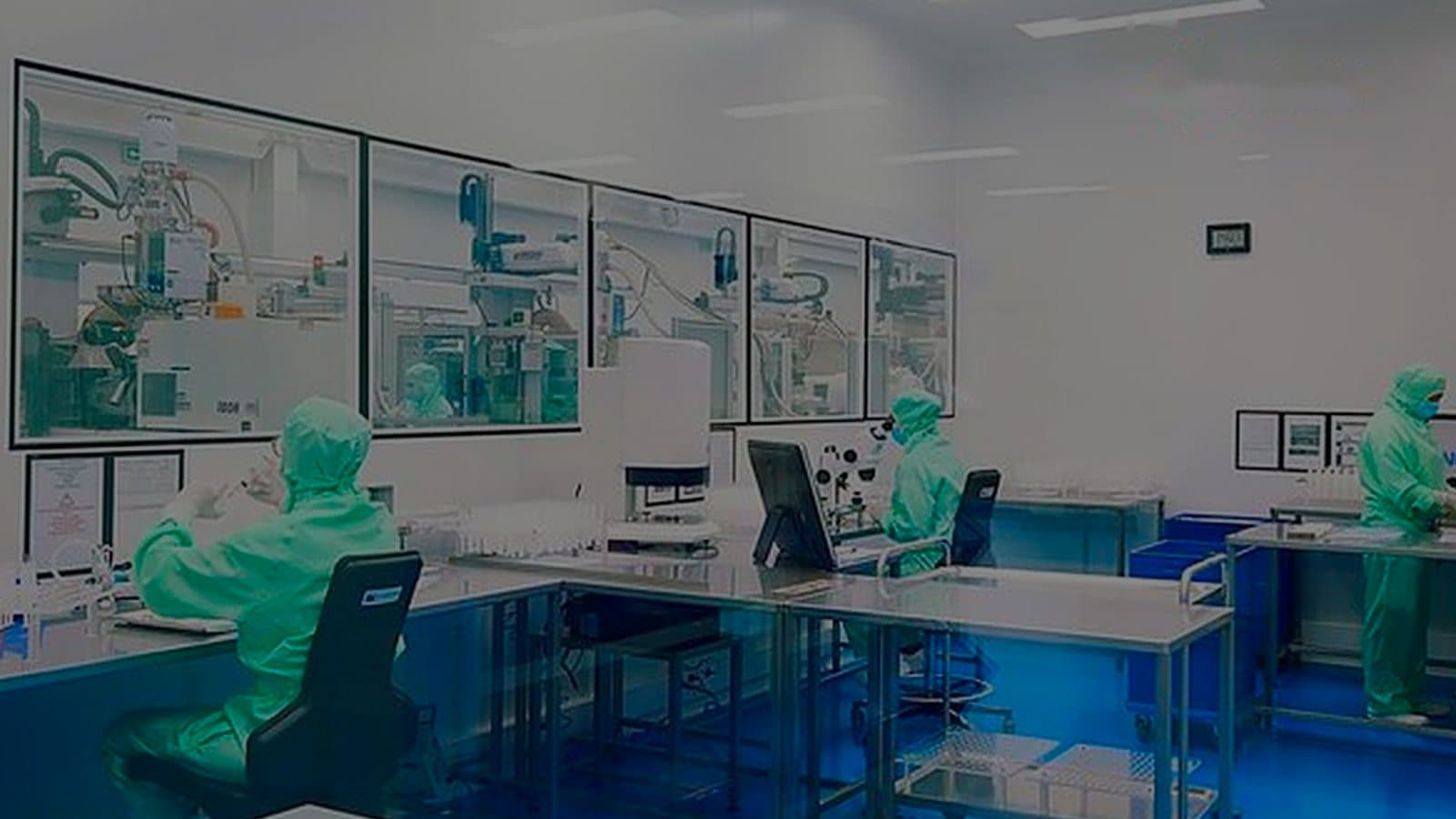
A filter changed on night shift without a leak test turns maintenance into a deviation. GMP maintenance works from criticality bands built on the asset register, planned and corrective work in one system, risk-based requalification and calibration, and 24/7 response across Southeast Asia under a maintenance agreement.
A sterile room is positive to protect the product; a high-potency OSD room must keep powder in. A cascade copied from a sterile template sends API dust into the corridor at every door opening. Check every door arrow, choose sink or bubble airlocks on purpose and extract through bag-in/bag-out HEPA housings.
EU GMP Annex 1 (2022) sets maximum requalification intervals: 6 months for Grade A and B cleanrooms and 12 months for Grade C and D. Classification, HEPA leak tests, airflow volume, pressure differentials and air velocity, or recovery where airflow is not unidirectional, are retested. A risk assessment can shorten these intervals, never extend them.
A Grade A particle counter samples one point and says nothing about the path air takes to the product. First air must reach an open container without passing over gloves or components. An in-operation smoke study that includes interventions is the evidence, and its findings belong in the Contamination Control Strategy.
21 CFR 211.42 and 211.46 and EU GMP Chapter 3 ask for adequate ventilation, air control and filtration, but give no air change rate or pressure differential, and no filter class beyond HEPA for aseptic areas. Those come from Annex 1, FDA's 2004 aseptic guidance, ISO 14644 and the designer's justification, recorded in the design basis.
ISO Class 1 allows 10 particles of 0.1 µm and larger per cubic metre; ISO 5 allows 100,000 at that size. At that level the installed leak scan must prove frames and grid, not just the U15 filter, single-digit counts need large sample volumes, and airborne molecular contamination needs its own sampling plan.
A 50 m² Grade B room needs 10 classification locations under ISO 14644-1:2015, and EU GMP Annex 1 requires them at rest against ISO 5 and in operation against ISO 7, with the smoke study in both states. Whether each run sits in OQ or PQ is for the URS and risk assessment to justify.
Ducted terminal HEPA and FFU ceilings can both reach Grade B or C. A ducted system sets airflow at one AHU fan; an FFU ceiling has many settings to hold, but a single failure stays local. Energy depends on fan efficiency and duct losses, so calculate it for the layout.
EU GMP Annex 1 expects the final stage of an airlock to be, at rest, the same grade as the cleanroom it leads into. Into Grade B, that means 3,520 particles of 0.5 µm per m³, terminal HEPA supply, its own pressure step and a place in environmental monitoring, not a transfer grille.
ISO 16890 rates filters as ePM10, ePM2.5 or ePM1, and broadly a filter must remove at least 50% of that particle fraction to earn the group. In a GMP air handling unit the pre-filter grade sets how fast the terminal HEPA loads, and so how often it is replaced and leak-tested.
Cleanroom inspectors ask for the same HVAC evidence: qualification report, pressure trends and alarm log, HEPA leak tests, classification and recovery, smoke studies, as-builts and change controls. Index them per room, with document number, revision and location, so the back room answers in minutes.
At 20 air changes an hour, ideal mixing gives a 100:1 recovery time of about 14 minutes; a poorly mixed corner acting like 10 ACH takes about 28. Swirl diffusers come closest to ideal, perforated faces mix less, and plain HEPA faces suit a critical bench. Place the recovery probe where air arrives last.