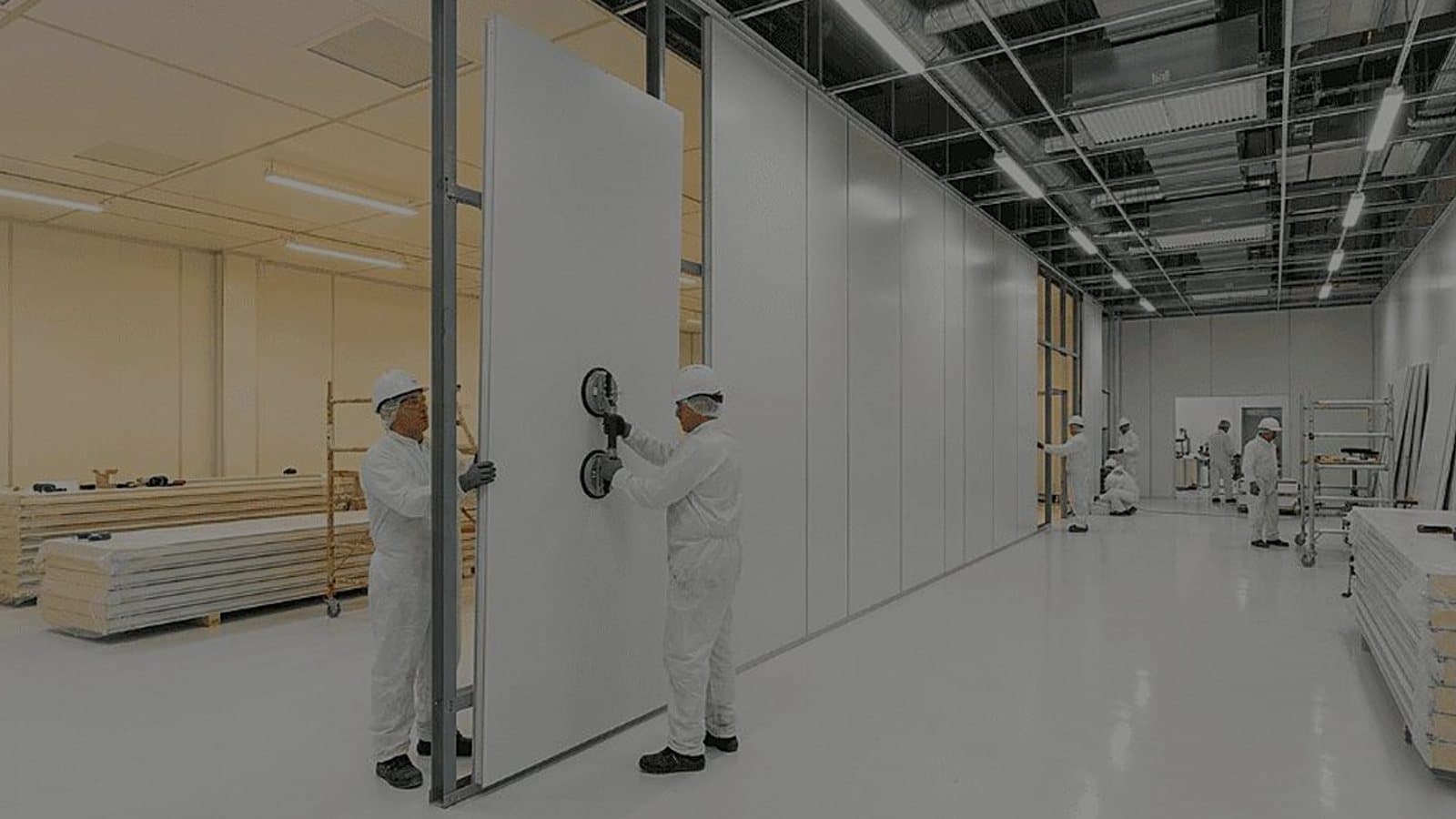
A new AHU started during construction loads its coil, drain pan and final filters with site dust that does not vacuum off wet fins. Clean the casing before power-on, seal duct openings, run on temporary pre-filters, fit final filters after the final clean and record it for IQ.
Duct leakage, cascade balance, controls tuning and recovery can only be measured once an AHU is connected on site. A FAT can still speed up those tests by recording clean filter and coil pressure drops, the casing leakage result, fan airflow at design static and the panel software version with its I/O list.
A 900 mm cleanroom door with a 5 mm undercut leaks about 50 m³/h at 15 Pa, and about 100 m³/h at 10 mm. Door gaps set how much offset air holds a 10–15 Pa cascade. Specify door leakage as a number at a stated pressure, with the test, and check it before installation.
Substitutions reach site through vendor drawings approved in a hurry. Before releasing fabrication, check the duty point at design conditions, materials in the air path, clearances against the BIM model, sensors against the BMS I/O list, and the certificates and FAT procedure that must come with the unit.
Heat tint is removed by pickling or mechanical cleaning, then passivation restores the oxide layer, and a treated part looks like an untreated one. The only proof is the record made at the time: procedure, chemical, contact time, date, operator and check. Collected during production, it means IQ starts from a complete file.
A FAT protocol written in the week of the FAT drifts toward what the unit already does. Approved with the drawings, it turns every specification line into a test with a method, instrument and acceptance value, such as stopping the fan to prove the heater trips, and sends unmeasurable requirements back to the spec before fabrication.
A FAT witness needs the approved drawings and datasheets at the order revision, the approved protocol with numeric criteria, the specification clause list, the expected test instrument list and an agreed punch-list format with someone authorised to sign it. Without these, a witness can only watch.
Score the technical envelope of a cleanroom HVAC tender and sign it off before any price is opened. Issue the scoring sheet with the tender: mandatory items pass or fail, the rest weighted, for example 40% technical depth and 20% each for documentation, delivery and service. Score every listed deviation.
A filter passing 5% of particles with 2% of the air slipping round its frame passes almost 7%. EN 1886 measures that bypass on the AHU casing, and class F9 allows 0.5%. Frames, gaskets, clamps and rails decide the result, so put the class on the data sheet and check it at FAT.
A hygienic AHU that passes FAT clean can still reach start-up full of site dust and condensation. Factory-fitted caps, wrapping that sheds rain without trapping moisture, desiccant for shipping, dry covered storage and an internal inspection before the first fan run protect what the FAT proved.
Cooling coils foul on the air-entering face, while water and growth appear on the leaving side over the drain pan. A hygienic AHU needs access sections upstream and downstream of the coil and a sloped, reachable drain pan that extends past the leaving face.