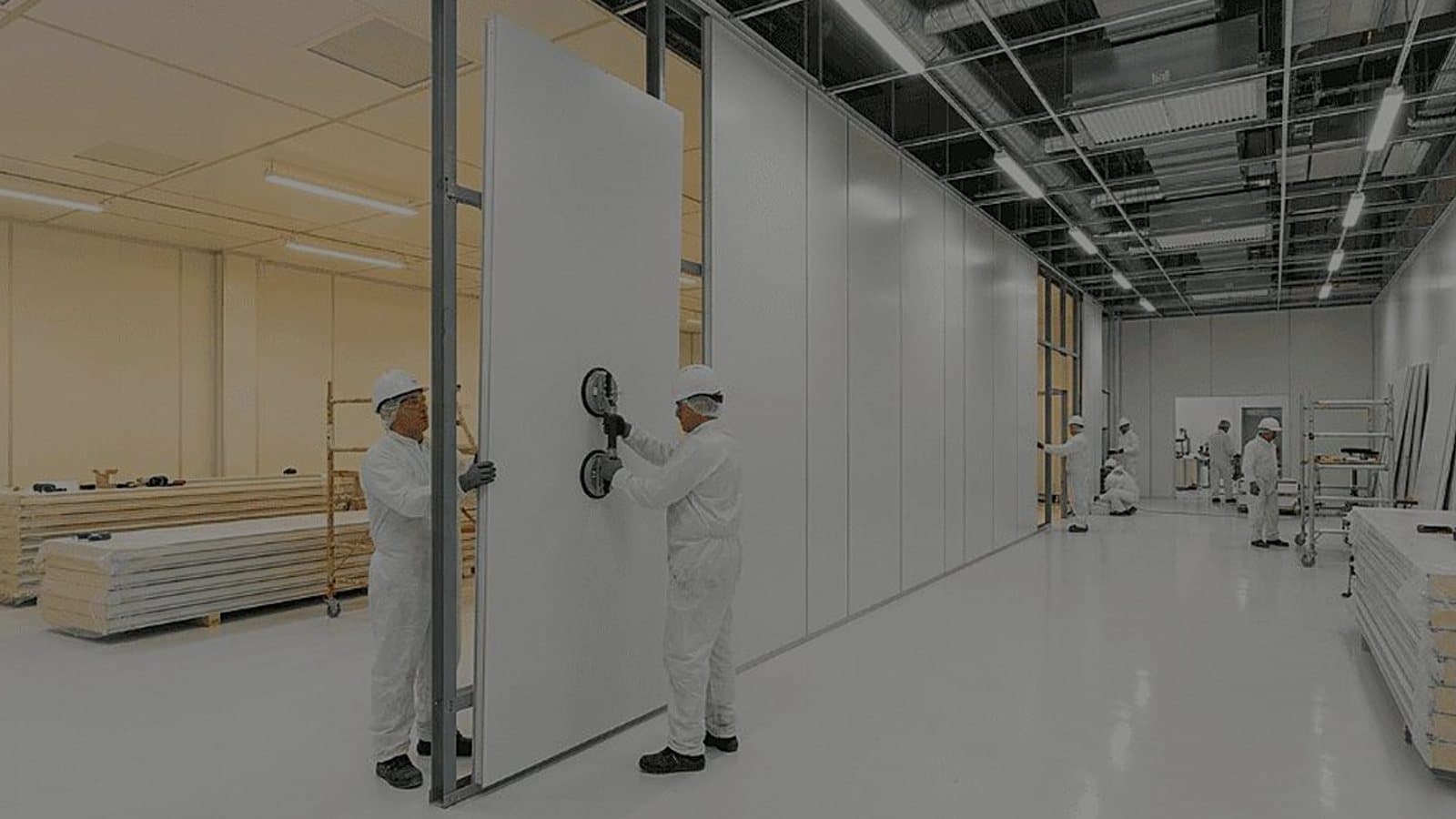
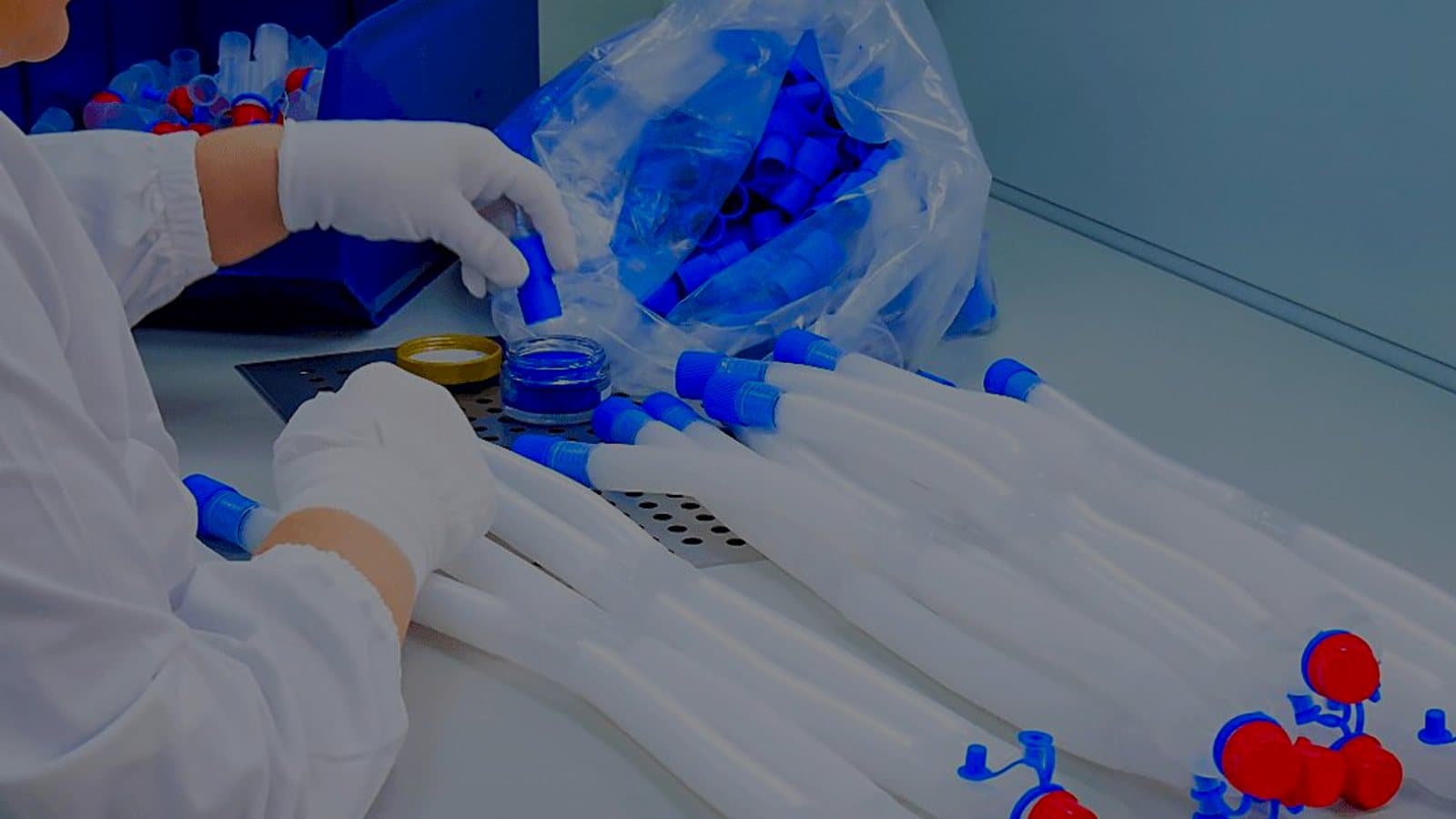
In many medical device plants, assembly and sterile-barrier packaging share one ISO class. Packaging is the last exposure before the seal, so it usually sets the class. Assembly can sit a step looser with its own ESD and humidity controls, unless no cleaning step separates the two rooms.
Drums routed through a personnel airlock months after start-up are a layout-stage mistake. Small items go through a pass box; carts and drums need a material airlock, a room with its own air, cleaning step and place in the 10 to 15 Pa cascade. Check size, then frequency, then pressure.
Many potent suites recirculate through safe-change HEPA housings; where the risk assessment rules that out, every cubic metre is tropical outdoor air. Run-around coils recover heat with the airstreams fully separated, wheels open a leakage path, and dedicated fresh-air pre-cooling targets the latent load. Our energy modeling targets a 30% HVAC energy reduction.
To a semiconductor engineer, Grade C at ISO 8 in operation looks loose. EU GMP Annex 1 adds microbial limits: 100 CFU/m³ in air, 50 per settle plate over 4 hours, 25 per contact plate. Rooms wiped with sporicide need floors and joints a fab never had to clean, and a CCS that ties the choices together.
A new AHU on a running suite moves the pressure cascade, so its event-driven requalification reaches the differential at every door it serves. Change control sets that scope. Annex 1 (2022) separately caps periodic cleanroom intervals at 6 months for Grade A and B and 12 for C and D.
An FFU array can average 0.45 m/s and still have a corner at 0.30 m/s. Measure each unit on a grid at FAT with fan speed settings recorded, then repeat the grid across the installed array at OQ. A flat map is healthy; a low edge points at speed, plenum, blanking or lights.
Annex 1 initial validation of an aseptic process needs at least 3 consecutive successful simulations covering all working shifts, then periodic runs twice a year per process, line and shift. The cleanroom must hold its qualified state throughout. Agree an HVAC freeze date with QA, and list in advance which jobs are like-for-like and which need an impact assessment.
A classified room's air change rate, recovery time and pressure steps were proved at one airflow. Constant volume holds each room's flow at that value with a terminal, while the fan speeds up as filters load. VAV moves supply with the cooling load, so it belongs in offices, technical areas and fume-hood exhaust.
Measuring every room against one reference stops errors stacking but leaves room-pair differences at up to ±2 Pa with ±1 Pa sensors. Room-to-room sensors show airflow direction directly but add errors along the chain. Record one set, compute the other, and state the error budget.
The scope of EU GMP Annex 1 (2022) says some of its principles, including the contamination control strategy, may be used for certain non-sterile products such as liquids, creams and ointments. A semi-solids plant that writes a CCS tying room grades, flows, water and monitoring to product risk has an answer for the inspector.
The US chapter USP <800> holds a hazardous-drug compounding room at 0.01 to 0.03 inches of water column negative to adjacent areas, about 2.5 to 7.5 Pa. The band has an upper limit as well as a lower one, so the transmitter, the exhaust control and the tightness of the room all matter more than in a 10 to 15 Pa cascade.
GMP cleanrooms are usually designed with 10 to 15 Pa between adjacent grades. ANSI/ASHRAE/ASHE Standard 170 sets a minimum of 0.01 inch of water, about 2.5 Pa, for hospital rooms such as isolation rooms and operating rooms. At that level door closers, seals, a sealed envelope and a monitor chosen for the range decide whether the pressure holds.