An AHU's section split and weight are set by the tightest point on its delivery route: door clear openings, lift car and rated load, corridor corners, crane reach and floor loading. Survey the route before the general arrangement is frozen, and plan a casing leakage check after site reassembly.
An AHU casing is described by five EN 1886 classes: strength D1–D3, leakage L1–L3, filter bypass up to F9, thermal transmittance T1–T5 and thermal bridging TB1–TB5. A witnessed FAT can test leakage on the real unit; transmittance and bridging come from a laboratory model box, so the model box report belongs with the offer.
A V-belt sheds rubber dust into the airstream for its whole life, and in a GMP supply AHU that dust loads the final filters. Belt drives also lose a few per cent of shaft power and need regular tensioning. Direct-drive plug fans avoid all three, though a large belt-driven housed fan can still win at high pressure.
When a supply AHU trips with extract fans running and dampers open, a Grade B room loses its 10–15 Pa margin and pulls air from the lower grade. Tight-shutoff dampers with a tested leakage class, defined fail positions, interlocks, proven position and a supply-first restart keep the cascade, and a deliberate fan trip at FAT proves it.
A fixed-speed fan filter unit loses airflow as its HEPA filter loads. Set at 0.45 m/s, it has 20% to lose before the 0.36 m/s bottom of the Annex 1 guidance range. Constant-airflow EC units hold velocity if they are selected at the final pressure drop, and their speed trend doubles as a filter-loading record.
A 0–10 V transmitter where the IO list says 4–20 mA passes a visual FAT and fails on site. That and four more defects (missing tags, gasket gaps, drain pans that hold water, missing documents) are worth checking at every AHU FAT against the approved specification and IO list.
A pass box exists for its interlock: one door stays locked until the other is shut. Each side needs an indicator showing why, a dynamic box should show when purge time has run, and the locks' behaviour on power failure must be decided in the risk assessment and tested at OQ.
An AHU condensate line piped directly into a floor drain gives backed-up water and sewer gas a route to the unit. Each AHU needs its own trap, then a visible air break into a tundish or trapped gully, sized to the local plumbing code. The gap also shows anyone passing whether condensate is running.
Most first-start damage to an AHU comes from something left inside or left bolted. Remove transit fixings, test insulation, bump the fan for rotation, run at low speed, then read current, vibration and bearing temperature before ramping to duty and recording the static pressure profile as the baseline.
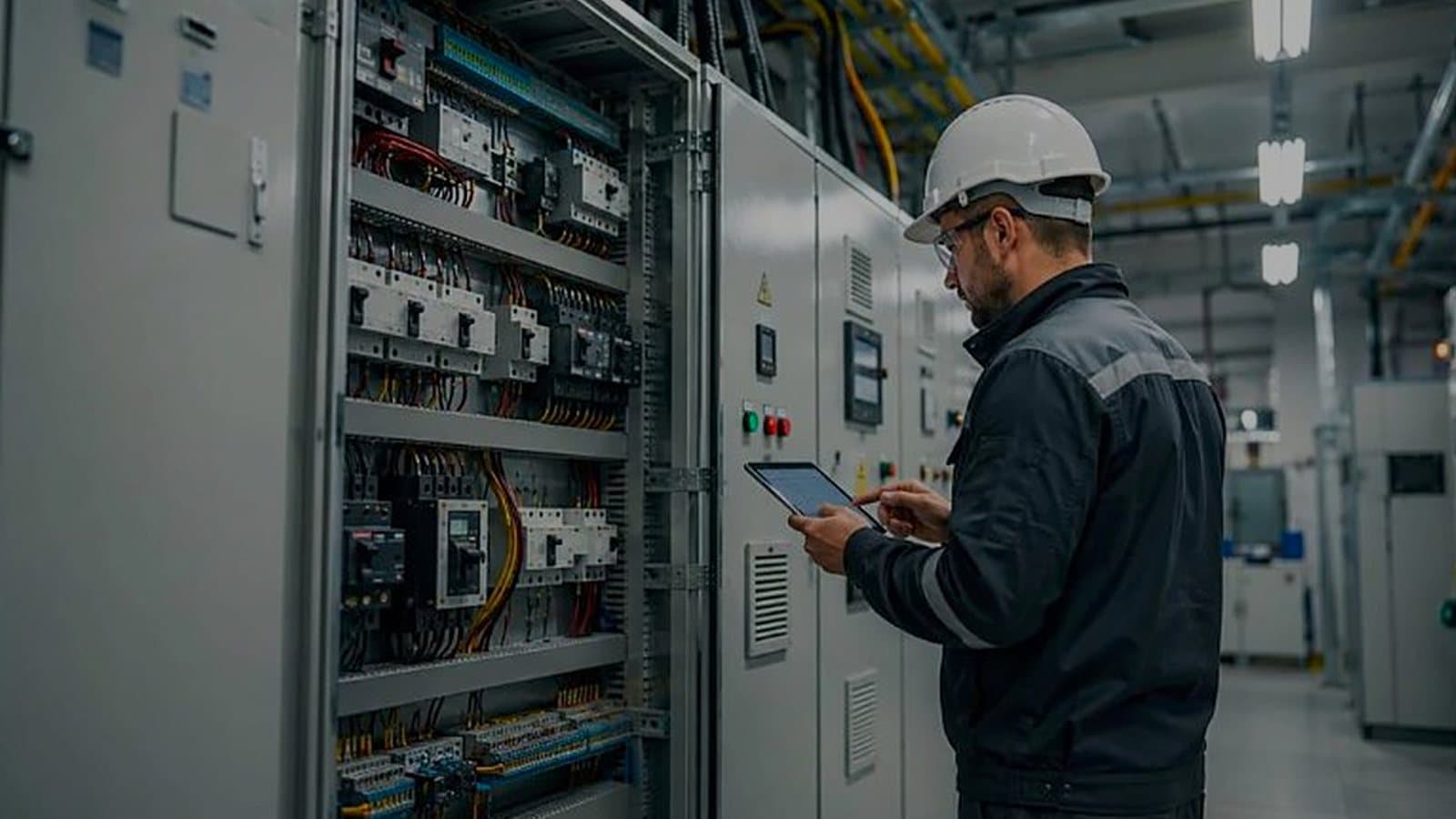
A panel that passed its factory test has since been transported, lifted and cabled. Before the incomer is closed: inspect inside and check torque marks, measure and record insulation resistance, compare protection settings with the coordination study, prove earth continuity and phase rotation, and confirm tools are out and covers on.
Default drive parameters will run an AHU fan but may not restart it after a power dip. Set the motor nameplate data, run the motor identification, set speed limits and ramps, add skip bands where the unit resonates, then decide and test behaviour on power loss, signal loss and fire mode. File the parameter list.
A chilled water coil piped in parallel flow still cools, so the error often survives commissioning. It shows as a valve at 100%, return water colder than design and an off-coil temperature that misses setpoint. Mark inlet and outlet at the factory, check at FAT, and look again before the insulation goes on.