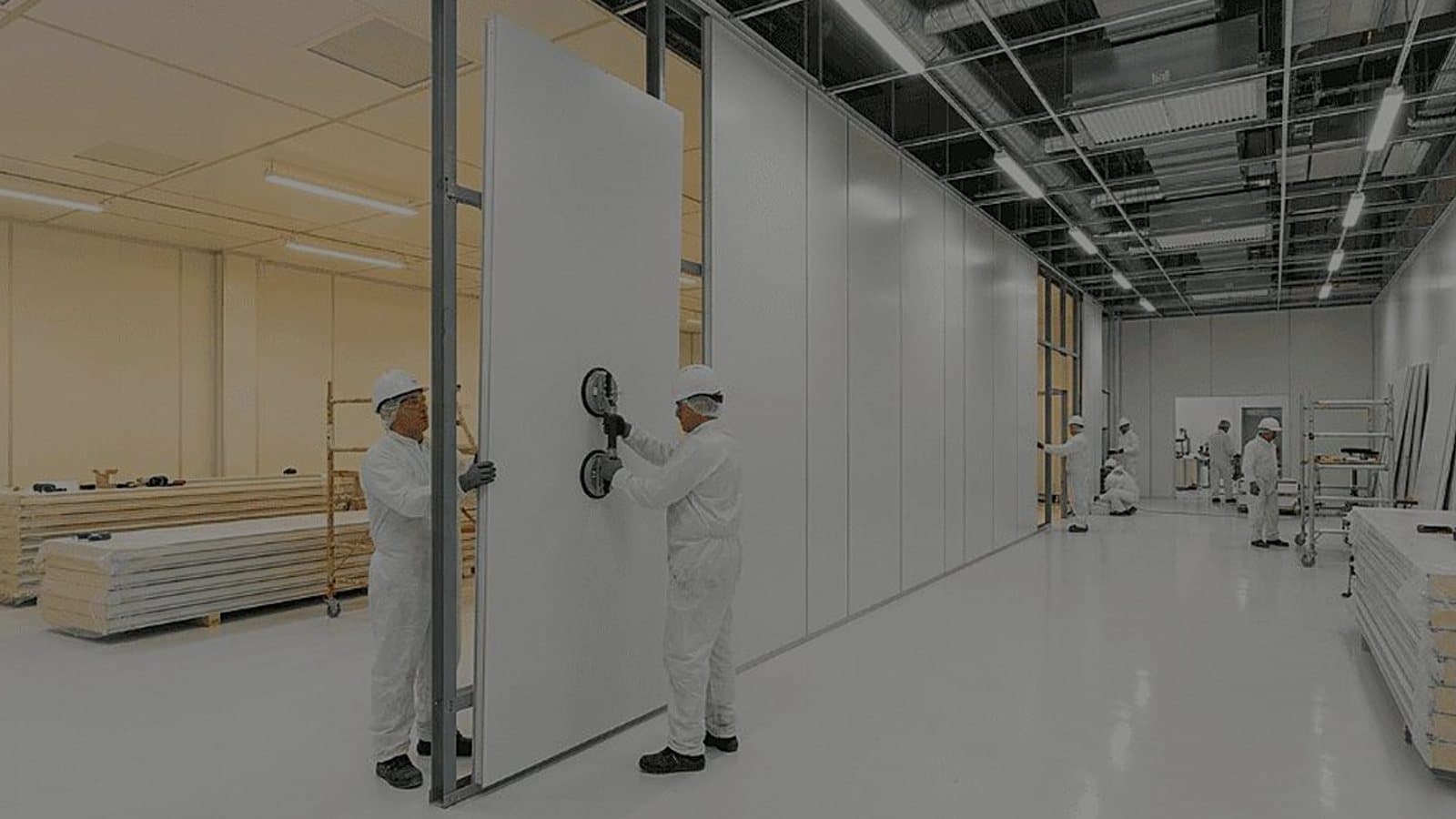
Masonry with epoxy paint is cheaper to build, but every later penetration in a classified room means drilling, repainting, cleaning and a particle count under change control. Before choosing, count how often each type of room in your current plant changed in the last five years; rooms that changed more than once usually repay panels.
Cleanroom inspectors ask for the same HVAC evidence: qualification report, pressure trends and alarm log, HEPA leak tests, classification and recovery, smoke studies, as-builts and change controls. Index them per room, with document number, revision and location, so the back room answers in minutes.
Energy measures that change validated cleanroom conditions go through Annex 15 change control. Classification alone can mean 10 sample locations for a 50 m² room, at rest and in operation, before recovery tests and a CCS update. Price that next to the kWh, or design reduced modes in and qualify them once.
EU GMP Annex 1 (2022) lists significant modification to the HVAC system among the reasons to repeat an aseptic process simulation. Changes to airflow pattern, pressure regime or filter housings in aseptic areas should reach QA with an engineering note before the work, and the requalification should be planned with the shutdown.
Grade D sets the particle limit and little else. In an OSD compression room the product is the contaminant, handled with a pressure sink and local exhaust; a semi-solids room has little dust but heat and water from vessels and washdown. Fill in the process loads on the room data sheet before copying any airflow.
Classification spreads sampling points evenly by floor area; environmental monitoring should go where contamination would reach open product first. Place particle probes and settle plates from the smoke study, the intervention list and a documented risk assessment, keep them clear of the flow, cover the last-to-recover spots, and reference the evidence behind each point.
EN 1822 ULPA classes add a nine each above H14: U15 99.9995%, U16 99.99995%, U17 99.999995% at MPPS. Semiconductor ISO Class 1 to 3 spaces need them. A pharma Grade A zone at ISO 5 rarely does, because people and seal leaks drive its counts; H14 with a sound seal usually carries it.
Shrinking a 10,000 m³/h duct from 700 × 500 mm to 600 × 400 mm raises velocity from about 8 to 12 m/s and velocity pressure from 38 to 80 Pa, so every fitting costs about twice. Set separate limits for mains and branches in the design basis.
If a Grade C area grows from 800 to 950 m² between concept and basic design and the estimate is carried forward, the design has 19% more cleanroom than the budget covers, found at tender. Write gate criteria before the meeting: design basis frozen, URS traced, estimate re-run, FMEA risks owned, a schedule the team can staff.
Bicarbonate-buffered media sit in incubators at around 5% CO2, and losing the supply raises the pH. Choose cylinders or bulk early, use a two-bank manifold whose changeover alarm reaches someone at night, and put the regulator, point-of-use filter and cleanroom penetration on the drawings.
ISO 14644-1 allows a room to be classified as-built: installation complete, services running, no equipment, materials or people. On a new suite it shows whether the HVAC, filters and envelope can reach the class alone. It says nothing about machines or people, so the GMP classification is still done at rest and in operation.
In unidirectional airflow at 0.45 m/s, a 28.3 L/min particle counter needs an inlet about 37 mm across to sample isokinetically, and a 100 L/min counter about 69 mm. An undersized inlet draws air in too fast, large particles miss it by inertia, and the ≥5 µm count reads low.