A FAT protocol written in the week of the FAT drifts toward what the unit already does. Approved with the drawings, it turns every specification line into a test with a method, instrument and acceptance value, such as stopping the fan to prove the heater trips, and sends unmeasurable requirements back to the spec before fabrication.
On positive-pressure AHU sections an outward-opening door is pushed off its gasket while the fan runs, so those doors should open inward and doors on negative sections outward. Where a positive-side door must open outward, fit a two-stage safety latch. Mark swing and latch type on the GA drawing, section by section.
Near the sea or heavy industry, condensate turns a copper-tube, aluminium-fin coil into a galvanic cell and the fin bond fails first. Coatings applied after assembly cover the cut edges that pre-coated fin stock leaves bare and the collars where its coating cracks. Select the coil with the maker's correction factor and ask for the salt-spray report.
In a draw-through AHU the coil section runs under suction. A trap seal shallower than that suction, about 51 mm of water column at 500 Pa, draws air in through the drain and floods the pan. Checking seal depth, fall and access on the walk-down avoids an OQ deviation.
A cooling coil dries air only to about its fin temperature; below 0 °C the fins frost. Dry rooms rely on desiccant rotors, down to −60 °C dew point, with a precooling coil removing bulk moisture cheaply first. Where that split sits sets most of the dry room's energy bill.
A FAT witness needs the approved drawings and datasheets at the order revision, the approved protocol with numeric criteria, the specification clause list, the expected test instrument list and an agreed punch-list format with someone authorised to sign it. Without these, a witness can only watch.
Score the technical envelope of a cleanroom HVAC tender and sign it off before any price is opened. Issue the scoring sheet with the tender: mandatory items pass or fail, the rest weighted, for example 40% technical depth and 20% each for documentation, delivery and service. Score every listed deviation.
AHUs bought in several tenders arrive with many motor frames, belt sections and filter sizes, and the spares list grows to match. A standardization schedule in the AHU datasheets before tender, covering IEC motor frames, standard filter faces, one sensor make and common belts, keeps the store small and repairs fast.
A filter passing 5% of particles with 2% of the air slipping round its frame passes almost 7%. EN 1886 measures that bypass on the AHU casing, and class F9 allows 0.5%. Frames, gaskets, clamps and rails decide the result, so put the class on the data sheet and check it at FAT.
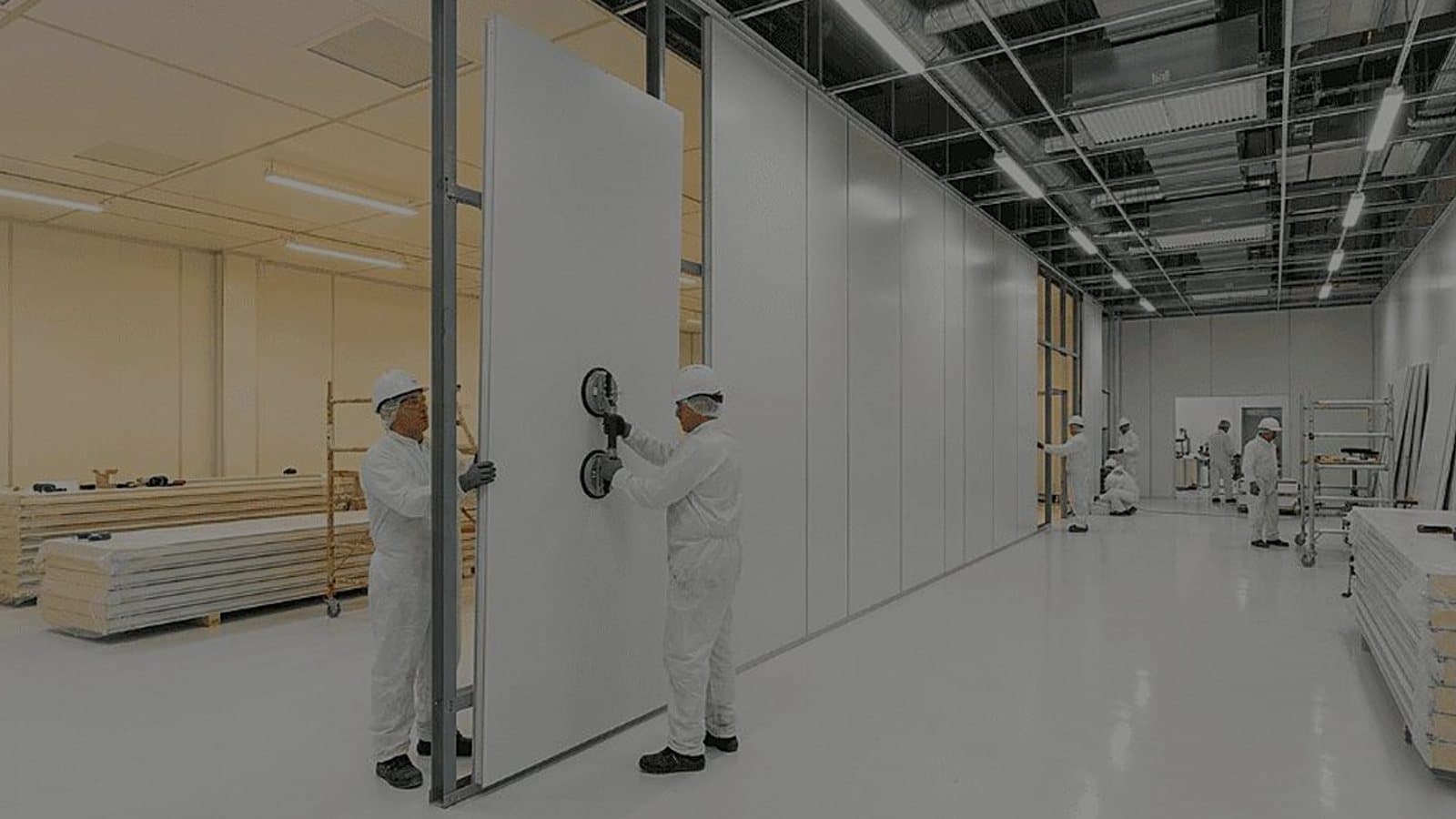
Low-level returns sweep particles down and out past the work, but each grille needs a riser to the ceiling void. Some modular wall systems can carry it inside the panel, flush with the room; ask before the layout is drawn. Use tool-free grilles, spread returns along the walls and seal the joints.
A hygienic AHU that passes FAT clean can still reach start-up full of site dust and condensation. Factory-fitted caps, wrapping that sheds rain without trapping moisture, desiccant for shipping, dry covered storage and an internal inspection before the first fan run protect what the FAT proved.
Airflow and kW alone leave a fresh-air coil's leaving dew point to the vendor's software. A comparable coil line adds entering dry and wet bulb at the wet-season design case, leaving dry bulb and dew point, chilled water temperatures, maximum face velocity and maximum air-side pressure drop.