When one location in a Grade C room recovers far slower than the rest, raising a 60 m³ room from 20 to 30 air changes adds 50% more air and may barely help. A smoke study usually shows short-circuiting to a return; moving or adding a low-level return is the cheaper fix.
The 2022 Annex 1 dropped the 1 m³ per location rule and points to ISO 14644-1, where Grade A at 0.5 µm needs about 6 litres a location (at least 2 L and 1 minute). Classification time goes on the number of locations including critical points, at-rest and in-operation runs, and 5 µm counting if the CCS calls for it.
The installed HEPA scan covers media, frame and the filter-to-housing seal, but not the flange between housing and ceiling. Where the ceiling void runs at higher pressure than the room, unfiltered air enters there. Seal it with an evenly compressed gasket and sealant bead, then probe the flange and file the result.
A timed airflow setback is simple to validate but blind to off-schedule activity. Particle-count-driven airflow follows real use and can save more, but counters and their failure modes join the validated system. Either way, the room must recover to its at-rest limits, pressures stable, before operations restart.
Cleanroom OQ tests depend on each other. Measure airflow first, then pressure differences, then the installed filter leak test, then airflow visualization, and finish with classification and recovery. A particle count taken before the leak test may have to be repeated once a filter is repaired.
Construction dust left in supply ducts ends up in the terminal HEPA filters, which then load in months. Order ductwork factory-cleaned and capped, store it off the floor, re-cap every open end at the end of each shift, inspect and wipe each section before connection, and fit the terminal filters last.
A terminal HEPA filter passes its factory test and is then carried through a building site. Clean the room and run on pre-filters first, unpack at the point of use, check the label against the position schedule, tighten evenly, then leak-scan the installed filter to ISO 14644-3 and record the serial number against its position.
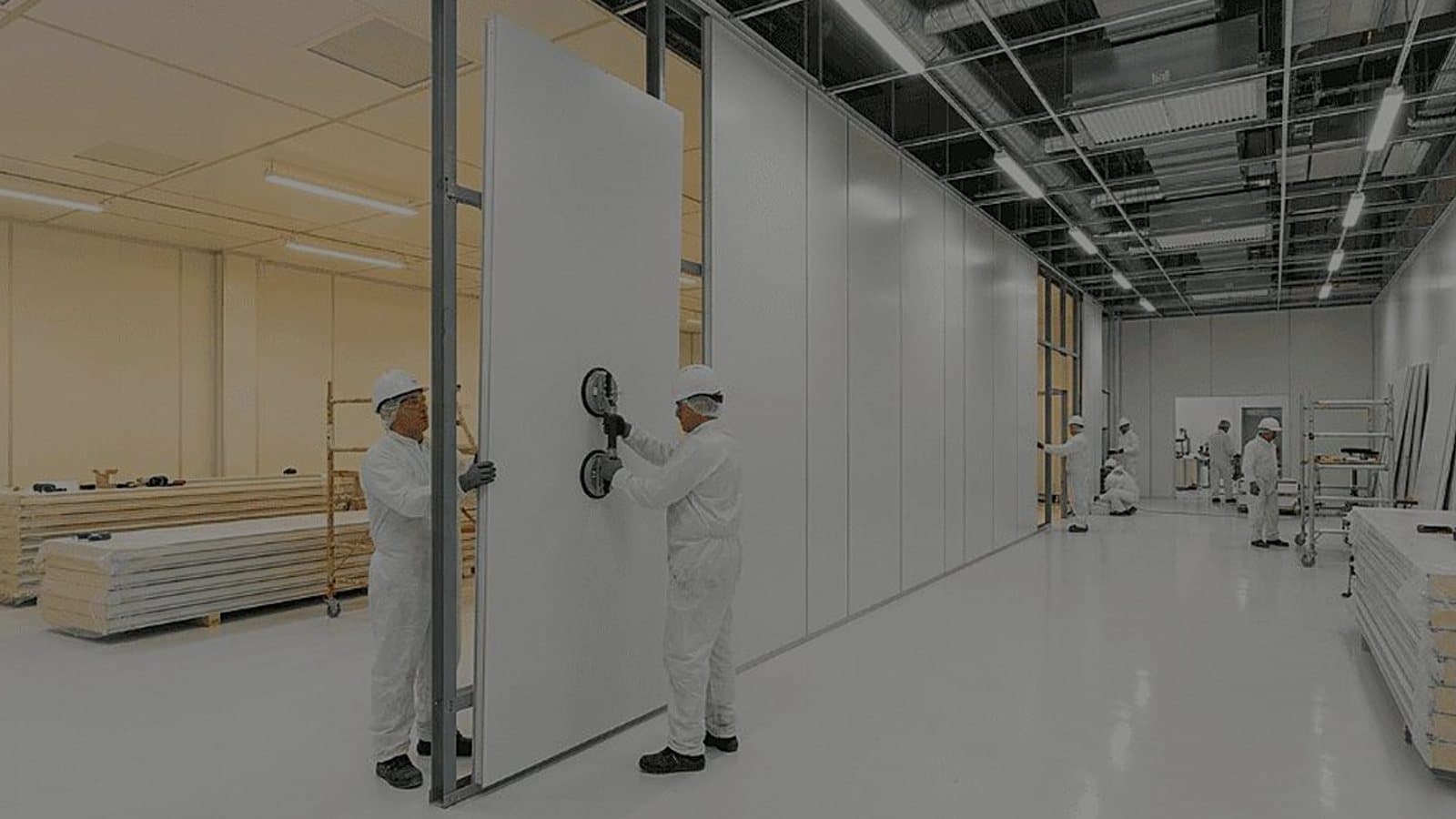
Dust built into a cleanroom is slow to remove. A clean build protocol stages the rules: dirty work first, then a closed envelope with no cutting inside, HVAC on temporary filters, a final clean with gowning, and terminal HEPA filters fitted last. Each stage needs an inspection and a signature before the next begins.
A room pressure loop tuned with every door shut hunts once production starts. Balance the airflows with the loop in manual, stroke the damper, tune from the reference room outward, then open and close doors and record the swing and the settling time. Those records are what the alarm delays should rest on.
ISO 14644-3 lists eleven supporting cleanroom tests and gives a method for each, from air pressure difference to segregation. It says they may not all be required and that tests should be selected in a manner agreed between customer and supplier. The test specification has to name the tests, the occupancy state and the acceptance criterion before the work is priced.
At 0.45 m/s across a 1 m clean zone the Reynolds number is about 30,000, far beyond laminar flow. ISO 14644-1 and the 2022 EU GMP Annex 1 use the term unidirectional airflow: steady velocity, roughly parallel streams. It is tested by air speed, uniformity and smoke studies, so write it that way in the URS.
Cleanroom testing is often bought late and on price, and QA first meets the tester as a signature on a report. Before the order, hold evidence of tester training, calibrated instruments, method statements to ISO 14644-1 and ISO 14644-3, a sample report and agreed raw data practice, then list the tester as an approved supplier.