EU GMP Annex 1 calls separate entry and exit change rooms for Grade B desirable. One room saves area but relies on procedure at the busiest shift change; two rooms give one-way flow at the cost of doors, air and qualification. On a new build, start from two.
A filter passing 5% of particles with 2% of the air slipping round its frame passes almost 7%. EN 1886 measures that bypass on the AHU casing, and class F9 allows 0.5%. Frames, gaskets, clamps and rails decide the result, so put the class on the data sheet and check it at FAT.
Before the supply fan is selected, check whether the coil sheet quotes a wet or a dry air pressure drop, and read it with the entering condition: dry- and wet-bulb at the peak dew point case. Then check leaving dew point against room RH, face velocity below about 2.5 m/s and a realistic chilled-water ΔT.
GAMP 5 software categories are 1, 3, 4 and 5; firmware stopped being Category 2 in 2008. Validation effort rises with each step, and a configured Category 4 SCADA can still hold Category 5 scripts that need custom-code testing. The 2022 Second Edition kept the categories.
At 22 °C and 45% RH, a 1 K temperature rise moves RH by about 2.5 points with no change in moisture. Hygroscopic products need staged drying controlled on dew point or RH, with the control sensor in the room, not a warm return duct. Humiley desiccant dehumidification is built to ±2% RH control.
Tag numbers, serials, locations, criticality and spares all pass through a project before handover. Name one person to hold the asset register from the design tag list, fill it through procurement and FAT, and check it at the IQ walkdown, so loading the CMMS at handover takes days rather than a months-long survey.
Requalification and calibration usually run on separate schedules with separate owners. Put them on one calendar: calibrate room sensors before requalifying, check test instrument certificates at pre-test approval, and assess the impact on every result when a sensor fails calibration.
Pure steam at 3 bar(g) saturates near 144 °C; at 3 bar(a), near 134 °C. A 134 °C sterilizer cycle needs about 3.04 bar absolute in the chamber, so a generator quoted at 3 bar absolute cannot reach it. Write the gauge or absolute suffix on every utility pressure.
Electrostatically charged filter media lose efficiency as the charge drains in service, while pressure drop barely changes. EN 779:2012 added a discharged minimum for F7 to F9; ISO 16890 rates ePM as the average of initial and discharged efficiency. Buy pre-filters on that rating.
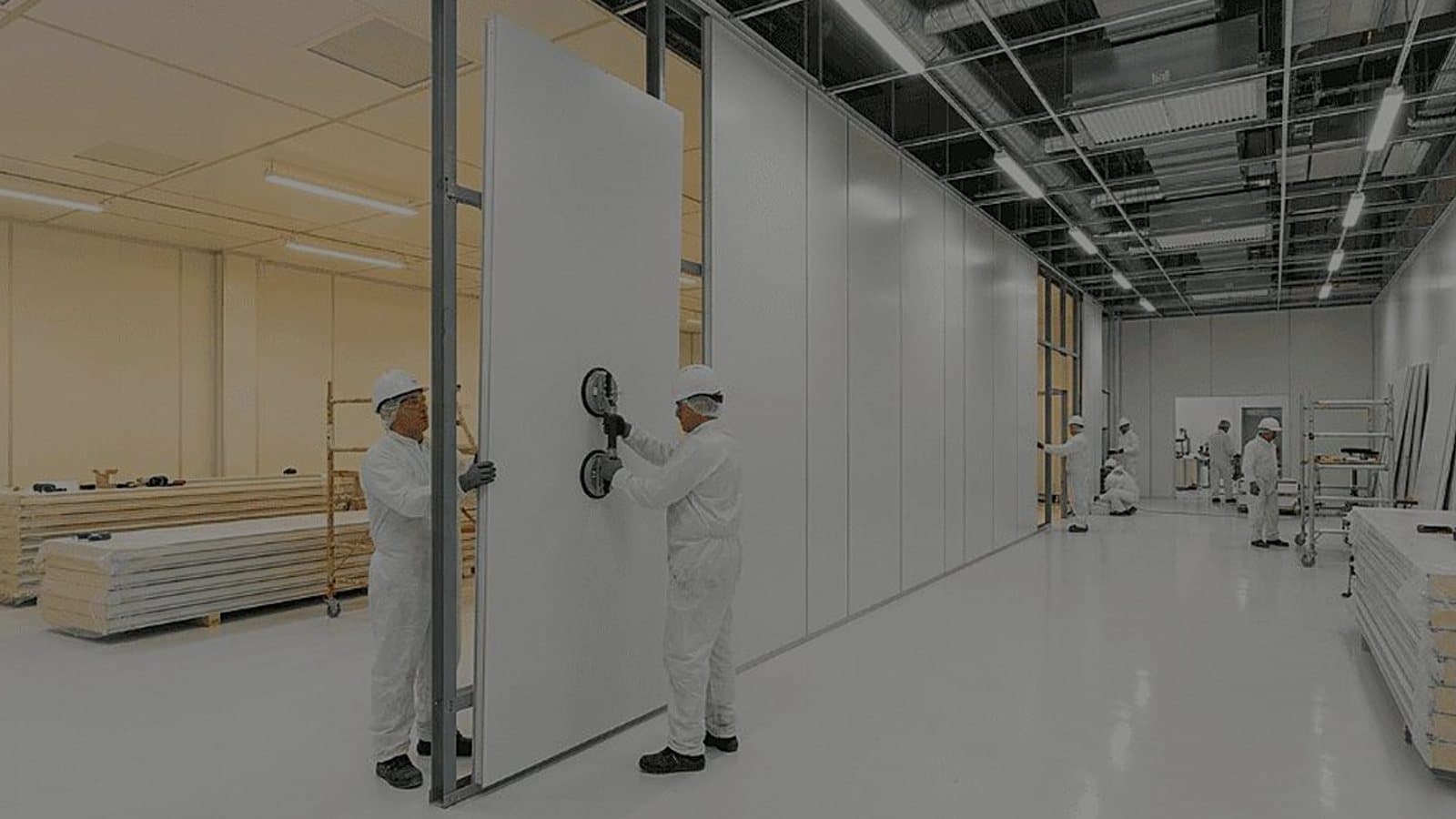
Low-level returns sweep particles down and out past the work, but each grille needs a riser to the ceiling void. Some modular wall systems can carry it inside the panel, flush with the room; ask before the layout is drawn. Use tool-free grilles, spread returns along the walls and seal the joints.
Duct airtightness classes A to D each allow about a third of the leakage of the class before. At 400 Pa, 500 m² of class B ductwork may leak about 220 l/s, class C about 75 l/s. Leakage after the flow control point moves the pressure cascade without the controller noticing.
A spreadsheet that calculates F0, an assay result or an airflow figure is a computerized system under EU GMP Annex 11 once its answer drives a GMP decision. Locked formula cells, one released template under version control and formulas checked once by hand are the minimum an auditor will look for.