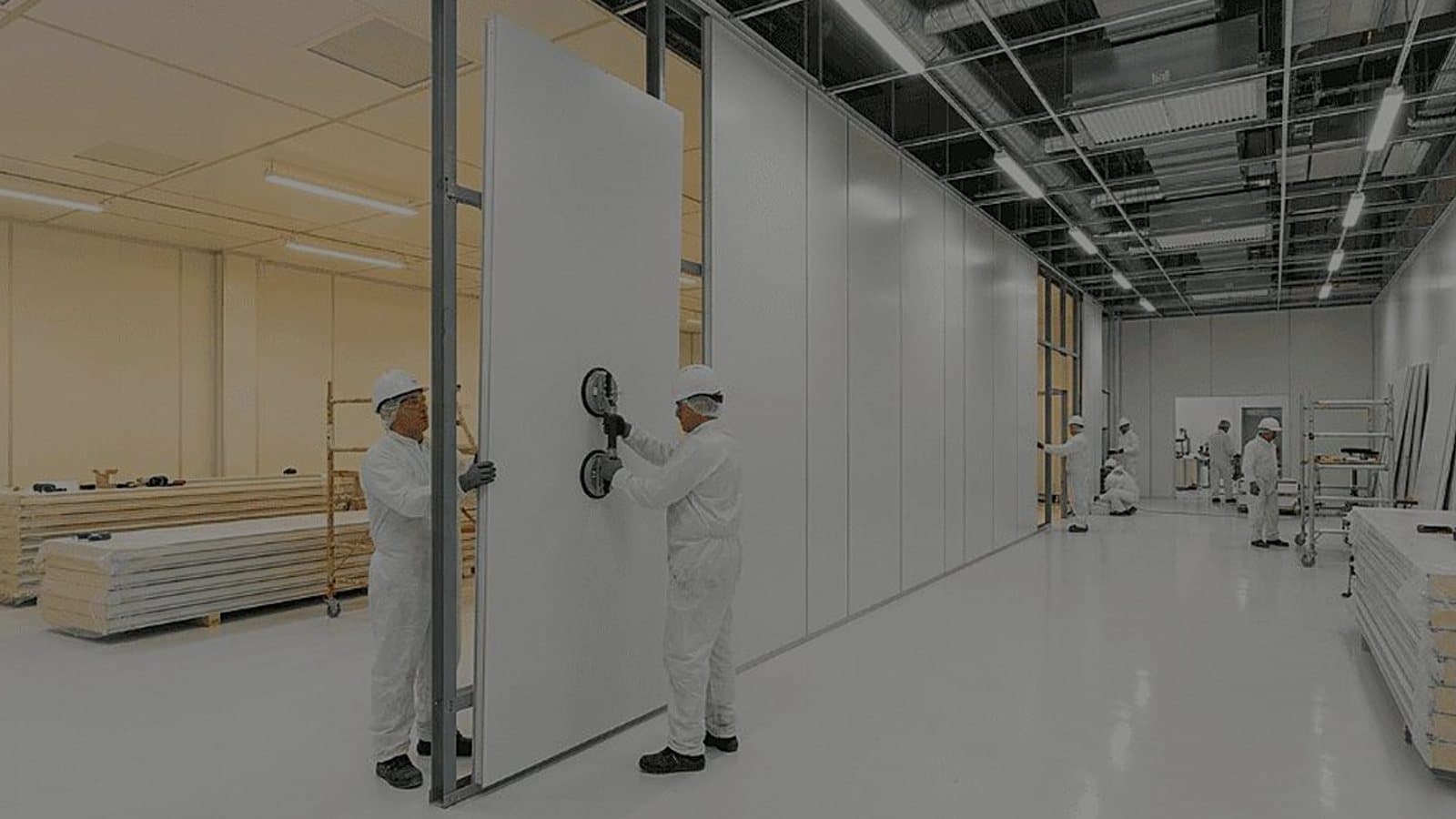
A square internal corner in a cleanroom holds residue and denies disinfectant its contact time. Coved junctions fix that, but only if the joint between cove profile and panel is flush and sealed. Agree the detail on a drawing and check the radius against the tool the cleaners actually use.
Recirculated cleanroom air returns near room condition and needs almost no dehumidification. In a worked wet-season example, 10,000 m³/h of fresh air costs about 186 kW of coil load. Remove avoidable fresh air from exhaust, leakage and over-pressurisation before investing in heat recovery devices.
A 900 mm cleanroom door with a 5 mm undercut leaks about 50 m³/h at 15 Pa, and about 100 m³/h at 10 mm. Door gaps set how much offset air holds a 10–15 Pa cascade. Specify door leakage as a number at a stated pressure, with the test, and check it before installation.
Tony Nguyen asks clients to test Humiley's younger engineers at design reviews with one question: what does the room do when the door opens? A Grade C room drawn 15 Pa above its corridor loses that difference with the door open. A good answer covers outflow through the doorway, the alarm delay and the recovery test.
When the fresh-air unit does all the drying and room AHU coils stay dry, every room's humidity depends on that one unit. Size its coil on the wet-season coincident condition, control on off-coil dew point, and decide in the design basis what happens when it trips.
In the wet season, outdoor air at 29 °C and a 26 °C dew point carries about 84 kJ/kg, against about 37 kJ/kg for cleanroom return air at 20 °C / 45% RH. Economiser hours are close to zero; tropical savings come from dehumidification strategy, avoided reheat, fan power and chiller lift.
On multi-contractor sites the decisions between scopes go unowned first: envelope penetrations, punch-list closure, construction cleanliness, interface as-builts and turnover sign-off. A RACI works when it names those decisions, with one accountable person each, and is reviewed whenever a scope changes.
ISO Class 1 allows 10 particles of 0.1 µm and larger per cubic metre; ISO 5 allows 100,000 at that size. At that level the installed leak scan must prove frames and grid, not just the U15 filter, single-digit counts need large sample volumes, and airborne molecular contamination needs its own sampling plan.
A chilled-water valve with 10 kPa across it on a 40 kPa coil branch has an authority of 0.2. At part load it sits near its seat, hunts, and the cleanroom dew point swings. Size the valve drop close to the branch drop, aim near 0.5, and check the opening at minimum load.
A replacement AHU supplying 5% more air, with a flow-controlled return and door gaps leaking roughly as ΔP^0.65, takes a door from 10 Pa to about 19 Pa. Fixed dampers and shared AHUs soften that, but requalification scope stays a change control decision: IQ always, OQ on the cascade, reasons recorded for any stage skipped.
In a draw-through AHU the coil section runs under suction. A trap seal shallower than that suction, about 51 mm of water column at 500 Pa, draws air in through the drain and floods the pan. Checking seal depth, fall and access on the walk-down avoids an OQ deviation.
Cleanroom load calculations fail on their inputs: nameplate equipment heat, table lighting density, office-level occupancy, missing process heat and forgotten fan heat, about 2 K at 1,500 Pa. Vendor heat-release data, the lighting design and the process description give better numbers than any default.