Divide a portable HEPA unit's clean-air delivery rate by the room volume: 300 m³/h in a 60 m³ room is 5 equivalent air changes an hour, at the rated speed. Ask for CADR at the night-time setting, place the unit so air crosses the patient's zone, and remember it neither pressurises the room nor replaces filtered supply.
A fixed-speed fan filter unit loses airflow as its HEPA filter loads. Set at 0.45 m/s, it has 20% to lose before the 0.36 m/s bottom of the Annex 1 guidance range. Constant-airflow EC units hold velocity if they are selected at the final pressure drop, and their speed trend doubles as a filter-loading record.
A HEPA canopy protects the wound only where its air reaches it. A canopy sized to the table leaves trolleys outside the column, and a flat lamp head leaves a recirculating wake over the incision. A smoke study with lamps, trolleys and staff in position shows both.
A pass box exists for its interlock: one door stays locked until the other is shut. Each side needs an indicator showing why, a dynamic box should show when purge time has run, and the locks' behaviour on power failure must be decided in the risk assessment and tested at OQ.
Critical spares sit for years before use. Store filters upright in their cartons and issue the oldest first, turn spare motor shafts at the manufacturer's interval, track shelf life on belts and seals, keep electronics dry in anti-static packaging, and label each item with the asset it fits.
A signature under 'read and understood' shows that reading happened. EU GMP Chapter 2 says training should be appropriate to the duties assigned and its practical effectiveness should be periodically assessed. Practical tasks need demonstration, supervised practice and an observed assessment, with SOPs sorted by risk to make that affordable.
Construction dust left in supply ducts ends up in the terminal HEPA filters, which then load in months. Order ductwork factory-cleaned and capped, store it off the floor, re-cap every open end at the end of each shift, inspect and wipe each section before connection, and fit the terminal filters last.
An H14 filter is rated for particles, at least 99.995% at the most penetrating particle size, and its leak test uses an aerosol. Solvent vapour passes through it. Vapours and gases need adsorption or scrubbing sized for the compound, or, where emission limits allow, a once-through exhaust discharged away from intakes.
A terminal HEPA filter passes its factory test and is then carried through a building site. Clean the room and run on pre-filters first, unpack at the point of use, check the label against the position schedule, tighten evenly, then leak-scan the installed filter to ISO 14644-3 and record the serial number against its position.
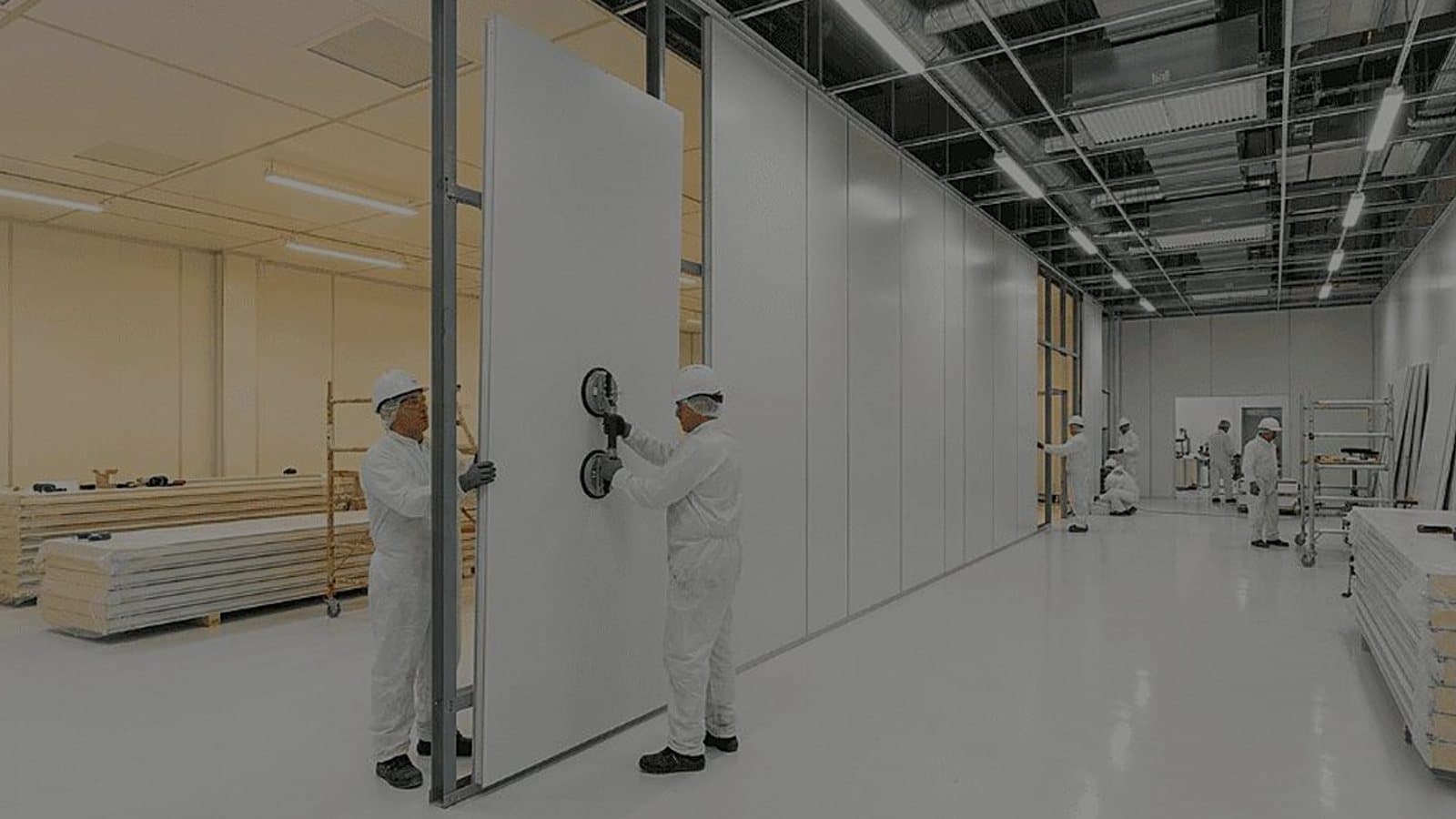
Dust built into a cleanroom is slow to remove. A clean build protocol stages the rules: dirty work first, then a closed envelope with no cutting inside, HVAC on temporary filters, a final clean with gowning, and terminal HEPA filters fitted last. Each stage needs an inspection and a signature before the next begins.
A risk priority number is three judgements on ranked scales, multiplied, so two competent teams can score one failure mode 40 and 160. ICH Q9(R1) says subjectivity cannot be completely eliminated but may be controlled. In practice: define the scoring scales, record the assumptions behind each score and use relevant data where it exists.
EN 1822-1:2019 places E10, E11 and E12 filters in the EPA group, below HEPA. Their class rests on an efficiency determined on a statistical basis, and the standard says group E filters cannot and shall not be leak tested for classification. H13 and H14 filters are individually leak tested. Use EPA as a pre-stage.