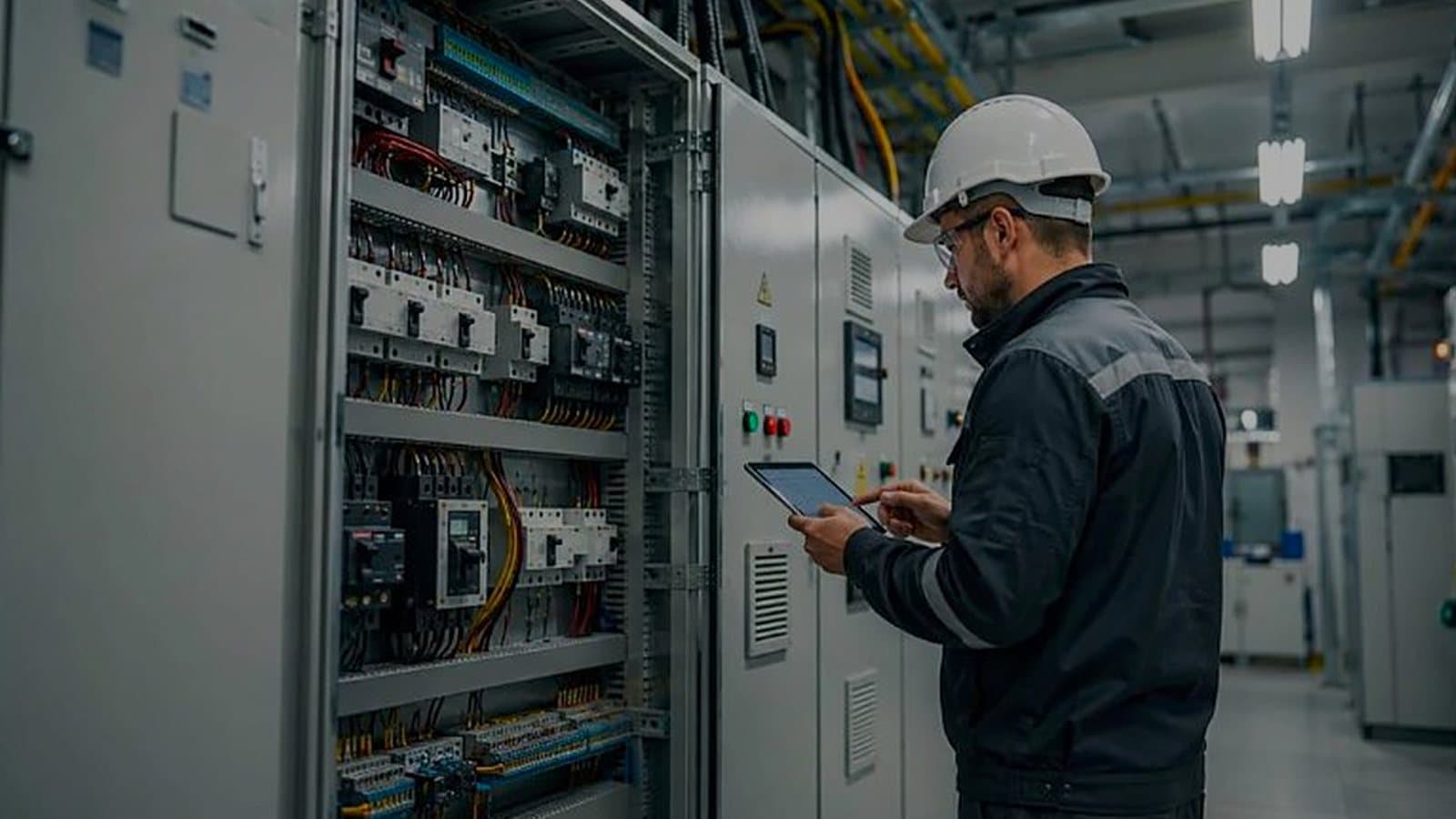
Filtration, AMC control, ±2% RH micro-environments and UHP utilities can each drift without an alarm. Designing facility monitoring with them, measuring at the tool, trending utilities and power on one time base and setting alert limits inside action limits, shows drift before the yield report does.
Environmental monitoring and BMS data that support GMP decisions must meet ALCOA+. In practice that means individual logins, time-synchronized controllers, an audit trail users cannot disable, alarms acknowledged with name and comment, and tested backups, with GMP-critical parameters separated early onto a validated system.
An AHF injects the opposite of the harmonic current its CTs measure, so CT position decides what it corrects. Put CTs on the fan-wall feeder, match source- or load-side CTs to the filter setting, and choose between a filter at each AHU and one at the main board before ordering.
A qualification test that fails on an unsealed penetration becomes a deviation; the same finding in commissioning is a punch item. Commission and balance first, close the punch items that affect the tests, then execute IQ and OQ on systems expected to pass, turning over one AHU and its rooms at a time.
EC fan drives without a DC choke typically draw 65–75% THDi; with one, 35–42%. Humiley's design target is 5% or less at the point of common coupling; IEEE 519-2022 limits TDD by short-circuit ratio. In a fan wall, identical units add up, so request harmonic data and a harmonic study at design stage.
LiPF6 electrolyte reacts with moisture to form hydrofluoric acid, which attacks electrodes and costs cell capacity, so the most moisture-sensitive Li-ion steps run at about 11 ppm of water vapor, a −60 °C dew point. Reaching it takes staged equipment (pre-cooling, a desiccant rotor and post-cooling), specified as a dew point measured where the process runs.
At 21 °C, 45% RH needs supply air near an 8.6 °C dew point; 55% RH needs about 11.6 °C. That 3 K is paid at the coil and in reheat every hour. Write each RH band from product data with its reason, and keep tight-band rooms off the AHU that serves the rest.
A wrong fan duty found at FAT means a revised test sheet; found on a live site it can mean a crane and a delayed OQ. A useful hygienic AHU FAT checks dimensions, casing leakage, fan duty, filter seals, control I/O and material records. Every AeroSano unit is FAT-tested and witnessed, with its equipment file compiled during production.
URS, DQ, IQ, OQ and PQ are drawn as a sequence, but every test on the right of the V-model depends on a measurable requirement on the left. Writing the URS before concept design and starting the traceability matrix on day one turns late site changes into early drawing changes.
EN 1822 rates H13 at 99.95% and H14 at 99.995% efficiency at MPPS. H14 earns its cost over open product in Grade A and on scan-tested terminal filters. In well pre-filtered Grade C and D rooms, H13 usually suffices, and a poor seal defeats either class.
ACH is supply airflow divided by room volume: 2,400 m³/h in a 120 m³ room is 20 ACH. It is an output of the class, heat load and 100:1 recovery time the room needs. Write those into the URS, keep ACH as a check, and prove the room with particle counts and a recovery test.
A 10–15 Pa differential between grades exists only while the door is shut. Once it opens, door swing, the operator's wake and any temperature difference between rooms drive air both ways. Holding adjacent rooms at the same temperature, keeping door-open time short and interlocking airlocks keep the exchange small.