Drying 10,000 m³/h of wet-season air from a 26 °C to a 9 °C dew point removes about 170 kg of water an hour, roughly 4 m³ a day at full load. The condensate is low in minerals and a candidate for reuse such as cooling tower make-up, after a site assessment.
True power factor is displacement power factor multiplied by a distortion factor. At 40% THDi that factor alone caps true PF near 0.93, so a board corrected to 0.98 DPF still reads about 0.91. More capacitors cannot close that gap; DC chokes and harmonic filters sized from a study can.
A cold room alarm that fires at every delivery soon goes unread. Plan the mapping study through a defrost cycle and a real delivery, in both seasons, then place the monitoring probe at the worst product point and set the alarm delay from how long a door-open peak actually lasts.
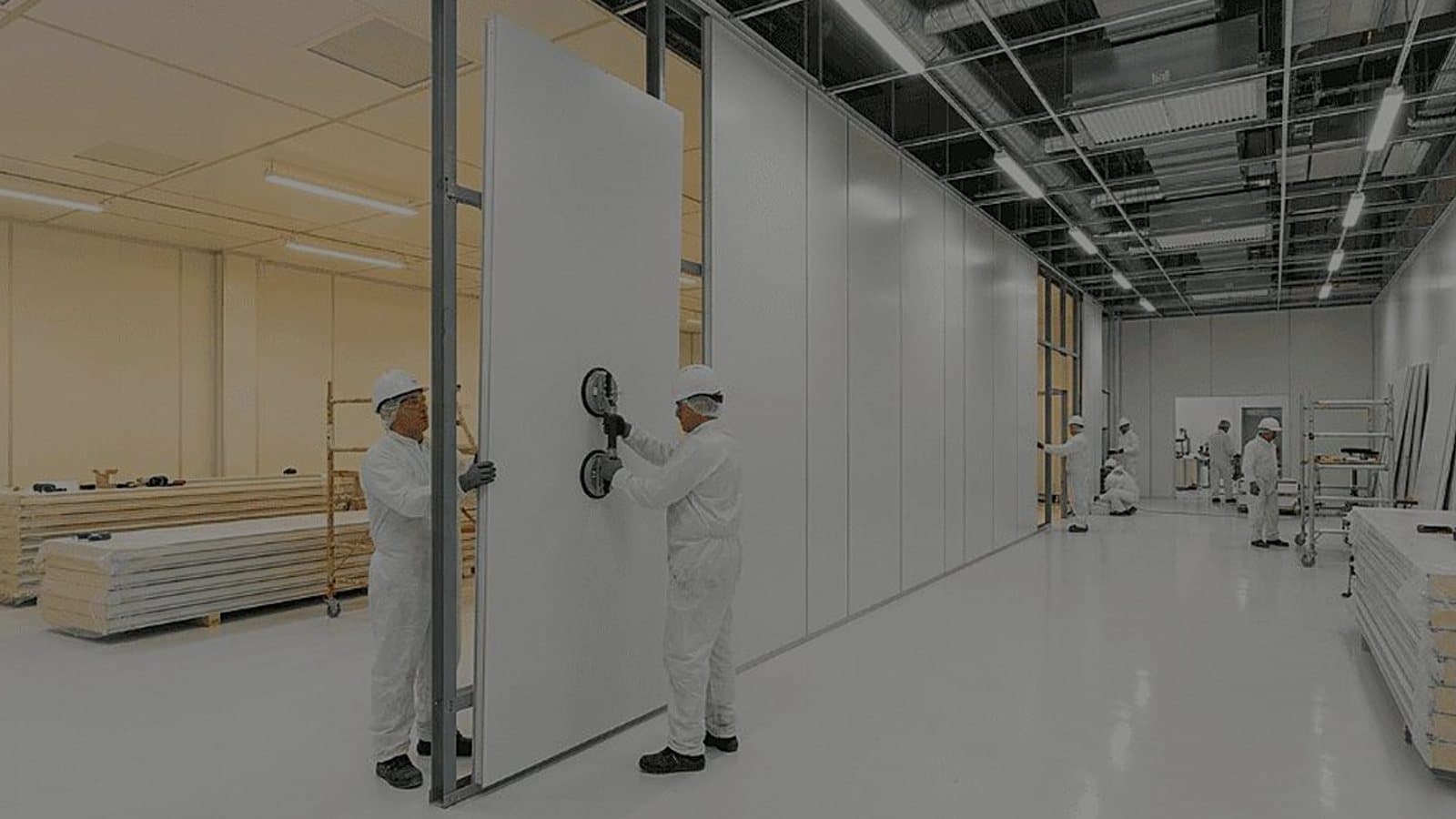
Masonry with epoxy paint is cheaper to build, but every later penetration in a classified room means drilling, repainting, cleaning and a particle count under change control. Before choosing, count how often each type of room in your current plant changed in the last five years; rooms that changed more than once usually repay panels.
A desiccant dehumidifier selection depends on six inputs: fresh and return airflow, air condition after pre-cooling, target dew point, reactivation heat source, leakage allowance and redundancy. −40 °C dew point is about 0.08 g/kg and −60 °C under 0.01 g/kg, a step that can add a rotor stage.
Before detail design opens, a GMP project should have frozen room data sheets and pressure cascade, loads that match the equipment list, a URS for each critical system and owned open items. A cascade change after the ducts are drawn reaches the duct sizes, terminal filters, AHU selection and every neighbouring pressure step.
Custom AHU factory slots can go before the design is final. A capacity reservation holds capacity and a delivery window against the owner's spec-freeze date: airflow and static pressure, coil duties, arrangement, EN 1886 casing classes and controls. A firm order placed too early turns each later design change into a priced variation.
A selection program will size a coil for any input, including a wrong one. Engineers who have worked the psychrometric chart by hand notice when an answer is off. Humiley's training pairs fundamentals with on-the-job work on real project packages, mentored by senior leads, starting from a 12-month internship.
Taking one AHU out of a running GMP plant changes the leakage balance of the rooms next door, and a 10 Pa step between grades can fall away. Seal shared air paths first, trim return dampers on the boundary rooms, record their original positions and keep EMS alarm limits at validated values.
For the same excess airflow, room pressure differential varies with the inverse square of the leakage area. On a finished cleanroom that area hides in door gaps, ungasketed light fittings, open socket boxes, panel joints and penetrations. Compare measured excess air with the design allowance at commissioning.
Lithography tools are often specified on the VC curves, where VC-D is 6.25 µm/s RMS. Fans, pumps and compressors reach the tool through the structure, so rotating plant location, tool floor type and flexible crossings belong in the layout, decided with the structural engineer before the slab is poured.
Under EU GMP Chapter 4, paragraph 4.11, a product with a 5-year shelf life keeps its batch documentation for at least 6 years. Environmental and BMS data that supported release is safest kept for the same period, so historian retention and storage belong in the URS for the BMS and EMS.